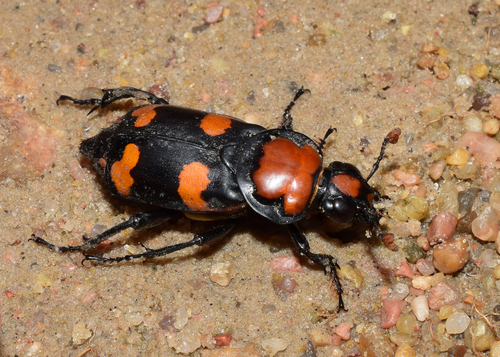
American Burying Beetle
Nicrophorus americanus
The American burying beetle is a rare, vibrant 'nature's recycler' known for its incredible strength and unique parental devotion. With its striking orange-on-black markings, this critically endangered insect is a prized discovery for any backyard observer.
Quick Identification
Size
25–45 mm (1.0–1.8 inches) in length; the largest carrion beetle in North America.
Colors
Shiny black body with four distinctive scalloped orange-red spots on the wing covers (elytra). A large, bright orange-red circular marking on the pronotum (the shield-like area behind the head) is the definitive identifier.
Key Features
- Large orange-red patch on the pronotum
- Four orange-red spots on shiny black wing covers
- Orange-tipped antennae with clubbed ends
- Large, robust body compared to other carrion beetles
When You’ll See Them
Geographic range
Where Does the American Burying Beetle Live?
Native to the North American continent, the American burying beetle was historically found across 35 U.S. states and parts of Canada. Today, its range is significantly restricted, with native populations occurring in isolated pockets of the United States, primarily in the Great Plains (Nebraska, Oklahoma, South Dakota) and a single island population in Rhode Island. These beetles require specific soil conditions and a lack of competition from larger scavengers to thrive in their remaining territories.
Basemap © OpenStreetMap contributors
Behavior
The American burying beetle is the ultimate 'undertaker' of the insect world, possessing an incredible ability to locate a carcass within hours of death. Working primarily under the cover of darkness, these beetles use sensitive chemical receptors in their antennae to detect the smell of decaying organic matter from up to two miles away. Once a suitable carcass is found—usually a small bird or rodent—a male and female will fight off competitors and begin the arduous task of burying the prize to protect it from larger scavengers like raccoons or crows.
Unlike the vast majority of insects, American burying beetles exhibit complex parental care. After stripping the carcass of fur or feathers and coating it in antibacterial secretions to slow decomposition, the female lays eggs in a side chamber. Both parents remain with the carcass to feed and protect the larvae, regurgitating food for them until they are old enough to feed themselves. This 'family' structure is highly unusual in the beetle world and is a key factor in the survival of their offspring.
EverydayEarth exclusive
Camera Tips
Capturing the American burying beetle on camera requires a specialized approach since they are strictly nocturnal and ground-dwelling. Position your camera very low to the ground, ideally no more than 6 to 12 inches high. Because these beetles are small compared to mammals, use a camera with a close focal range or a dedicated macro setting. If your camera has an adjustable infrared flash, set it to a lower intensity to avoid 'blowing out' the details on the beetle's reflective black shell.
The most effective way to attract this species for a 'backyard' survey is through scent. A small piece of raw, slightly aged chicken liver or a dead mouse placed inside a small wire mesh cage (to prevent cats or raccoons from stealing it) works as a powerful lure. Place the bait directly in front of the camera lens. The mesh is vital; it ensures the beetle can reach the bait to investigate, but larger animals won't run off with your setup.
Timing is everything for this rare insect. They are most active on warm, humid nights when the temperature remains above 60°F (15°C). Set your camera to take short, high-resolution videos (10-15 seconds) rather than still photos. This allows you to observe their unique 'phoretic' mites—tiny hitchhikers often seen crawling on the beetle's back—which are a fascinating part of their biology. Ensure your camera's date and time stamps are accurate, as this data is incredibly valuable for local conservation groups tracking this endangered species.
Similar Species
Species that look similar or are commonly confused with American Burying Beetle.
Frequently Asked Questions
Record American Burying Beetle at your habitat
Connect a camera to start building your own species record — AI identifies every visitor automatically.