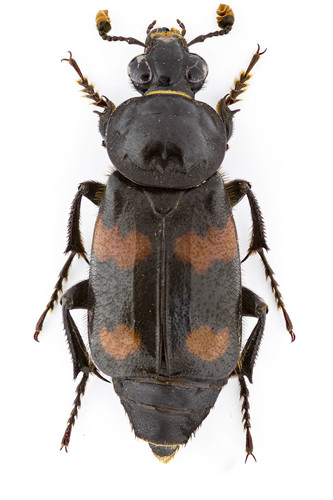
Roundneck Sexton Beetle
Nicrophorus orbicollis
A fascinating nocturnal recycler, the Roundneck Sexton Beetle is the forest's master undertaker. Known for its devoted parental care and striking orange-on-black markings, this beetle plays a vital role in keeping our ecosystems clean.
Quick Identification
Size
15 to 25 mm (0.6 to 1.0 inches) in length
Colors
Glossy black body with two distinct orange-red scalloped bands across the elytra (wing covers); antennae tipped with orange-red clubs
Key Features
- Distinctly rounded and smooth black pronotum (thorax plate)
- Four bright orange-red markings on the back
- Clubbed antennae with orange-red tips
- Large, powerful mandibles for moving soil
When You’ll See Them
Geographic range
Where Does the Roundneck Sexton Beetle Live?
The Roundneck Sexton Beetle is a native inhabitant of North America, boasting a wide distribution across the eastern and central parts of the continent. Its territory extends from southern Canada, including Ontario and Quebec, down through the eastern United States to the Gulf Coast, and as far west as the Great Plains. Within this range, it is most prolific in temperate regions where consistent moisture and forest cover provide the ideal conditions for its subterranean nursery habits.
Basemap © OpenStreetMap contributors
Behavior
The Roundneck Sexton Beetle is nature's most industrious undertaker. These beetles are renowned for their highly specialized reproductive behavior, which involves locating the carcass of a small animal, such as a mouse or sparrow, and burying it beneath the soil. Working in pairs, a male and female will excavate the earth from under the carcass until it sinks, then strip it of fur or feathers and coat it in preservative oral and anal secretions to slow decomposition.
Unlike the vast majority of insects, Sexton Beetles exhibit remarkable parental care. After the female lays eggs in a nearby tunnel, both parents stay to guard the 'brood ball' from competitors. When the larvae hatch, the parents actually feed them regurgitated liquid food, much like a bird feeds its chicks, until the young are capable of feeding themselves on the preserved carcass.
While they spend much of their time underground or hidden in leaf litter, they are strong fliers. They use extremely sensitive chemical receptors on their antennae to detect the scent of death from miles away, often arriving at a fresh carcass within hours of an animal's passing.
EverydayEarth exclusive
Camera Tips
Capturing the Roundneck Sexton Beetle on camera requires a dedicated 'macro' approach because of their small size and nocturnal habits. To increase your chances, set up a bait station in a shaded, wooded corner of your yard. A small piece of pungent meat or even a tablespoon of wet cat food placed in a shallow dish will act as an irresistible lure. Place your camera on a tripod just 6 to 12 inches away from the bait, angled slightly downward to capture the beetle's back markings.
Since these beetles are strictly nocturnal, ensure your camera's infrared (IR) flash is optimized for close-range subjects to avoid 'white-out' on their shiny, reflective black bodies. If your camera allows for focal adjustment, set it to the shortest possible distance. If you are using an AI-powered camera, make sure the sensitivity is set to 'High' to trigger on the relatively small movement of an insect.
The best time to film them is on warm, humid summer nights when the air is still. You can often capture fascinating footage of the 'tussle' that occurs when multiple beetles arrive at the same bait. For the best educational footage, try to capture them as they begin the 'bulldozing' process—plowing through the dirt to move the food source. Look for them from late spring through late summer, as they enter diapause (hibernation) deep in the soil once the first frost arrives.
Similar Species
Species that look similar or are commonly confused with Roundneck Sexton Beetle.
Frequently Asked Questions
Record Roundneck Sexton Beetle at your habitat
Connect a camera to start building your own species record — AI identifies every visitor automatically.