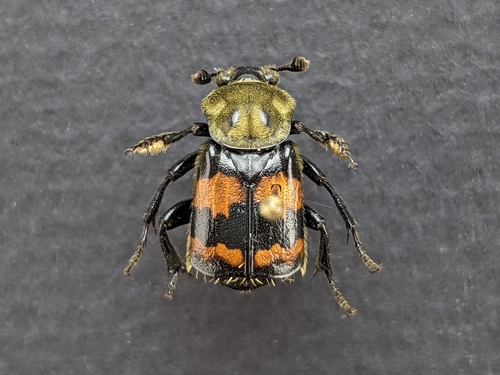
Tomentose Burying Beetle
Nicrophorus tomentosus
The Tomentose Burying Beetle is the golden-haired undertaker of the forest floor. With its striking orange-on-black pattern and incredible parental instincts, this beetle transforms decay into new life.
Quick Identification
Size
12–22 mm (0.5–0.9 inches) in length
Colors
Jet black body with two prominent, scalloped orange-red bands on the wing covers (elytra). Distinguished by a dense coat of golden-yellow hair on the pronotum (upper thorax).
Key Features
- Dense golden-yellow hair on the pronotum
- Two wavy orange bands on black wing covers
- Short, clubbed antennae with orange tips
- Wide, powerful legs adapted for digging and moving soil
When You’ll See Them
Geographic range
Where Does the Tomentose Burying Beetle Live?
Native to the North American continent, the Tomentose Burying Beetle is widely distributed throughout the Eastern and Central United States and Southern Canada. Its territory reaches from the Atlantic coast as far west as the Rocky Mountains, though it is most densely populated in temperate regions with moist soil and seasonal leaf drop.
Basemap © OpenStreetMap contributors
Behavior
The Tomentose Burying Beetle, often called the 'Sexton Beetle,' acts as one of nature's most efficient recyclers. Unlike many of its relatives that are strictly nocturnal, this species is frequently active during the day. They possess a highly sophisticated sense of smell, using chemical receptors on their antennae to detect the scent of a fresh carcass—usually a small rodent or bird—from over a mile away. Once a carcass is located, male and female beetles often cooperate to defend it from rivals and prepare it for their offspring.
Unique among the Nicrophorus genus, the Tomentose Burying Beetle does not always bury its prize deep underground. Instead, it typically excavates a shallow depression beneath the carcass, allowing the body to sink slightly, and then meticulously covers it with a camouflaging layer of leaf litter and loose soil. They exhibit remarkable parental care, with both parents often staying to feed the larvae by regurgitating liquefied food until the young are able to feed themselves on the 'brood ball.'
These beetles also maintain a fascinating symbiotic relationship with phoretic mites. You will often see small mites hitching a ride on the beetle's back. When the beetle arrives at a carcass, the mites hop off and consume fly eggs and small maggots, reducing the competition for the beetle's own larvae. In exchange, the mites get a free ride to their next meal.
EverydayEarth exclusive
Camera Tips
Capturing the Tomentose Burying Beetle on camera requires a dedicated ground-level setup. Because these insects are relatively small and stay close to the earth, you should place your AI-powered camera or macro lens just 3 to 5 inches off the ground. Positioning the camera at a 45-degree downward angle toward a patch of open soil or thin leaf litter provides the best perspective of their intricate markings and the golden fuzz on their thorax.
To guarantee a sighting, you will likely need to use a lure. A small piece of raw chicken or beef placed inside a perforated container (to prevent them from immediately dragging it away) will act as a scent beacon. Because this species is uniquely diurnal, you don't need to rely solely on night vision; the best footage is often captured in the late morning or early afternoon during the peak of summer and early autumn. Set your camera's trigger sensitivity to the highest possible level, as the movement of a single beetle may not always trigger standard PIR sensors.
If your camera supports time-lapse mode, this is the superior way to document their behavior. A frame every 30 seconds can reveal the incredible process of how these small insects move a carcass many times their own weight and disappear it under the leaves in a matter of hours. Be sure to clear away tall blades of grass directly in front of the lens to prevent 'motion blur' or focus hunting that can ruin a shot of these fast-moving beetles.
Similar Species
Species that look similar or are commonly confused with Tomentose Burying Beetle.
Frequently Asked Questions
Record Tomentose Burying Beetle at your habitat
Connect a camera to start building your own species record — AI identifies every visitor automatically.