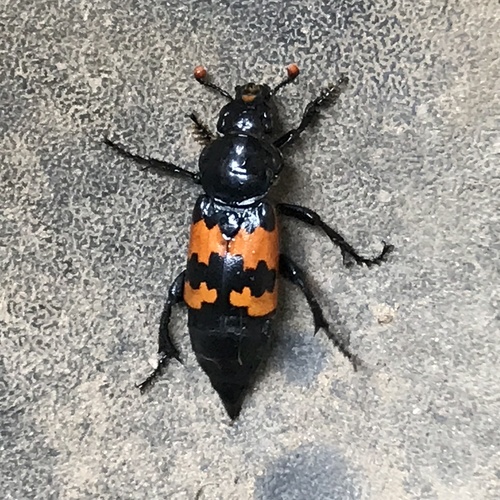
Margined Burying Beetle
Nicrophorus marginatus
Meet the 'sexton' of the insect world, a colorful recycler that performs a vital role in our ecosystems. With its brilliant orange markings and fascinating social life, the Margined Burying Beetle is a backyard marvel hiding in plain sight.
Quick Identification
Size
12–28 mm (0.5–1.1 inches) in length
Colors
Shiny black body with two distinct wavy red-orange bands across the wing covers (elytra). The clubs at the tips of the antennae are also bright red-orange.
Key Features
- Shiny black body with bold red-orange wavy bands
- Bright red-orange clubs at the tips of the antennae
- Entirely black, shield-like pronotum (area behind the head)
- Large, robust build with powerful legs for digging
When You’ll See Them
Geographic range
Where Does the Margined Burying Beetle Live?
This striking beetle is a native inhabitant of North America, where it boasts one of the widest distributions of any burying beetle on the continent. Its core range stretches across the United States and southern Canada, thriving in diverse environments from the Atlantic coast all the way to the Rocky Mountains. While it is less common in the deep desert or dense boreal forests, it is a frequent visitor to backyard ecosystems across the American Midwest and Great Plains.
Basemap © OpenStreetMap contributors
Behavior
The Margined Burying Beetle is one of nature's most dedicated cleanup crews. These beetles are famous for their remarkable parental care, which is rare in the insect world. Upon finding a small vertebrate carcass, such as a mouse or a small bird, a male and female pair will work together to excavate the earth beneath it, literally "burying" the remains to protect it from competitors like flies and larger scavengers. Once underground, they strip the fur or feathers, roll the carcass into a ball, and coat it with antimicrobial secretions to preserve it.
What sets them apart is their social complexity. Unlike most insects that lay eggs and leave, these parents stay with their larvae after they hatch, feeding them regurgitated food and defending the brood from intruders. While they are often associated with death, they play a vital ecological role by recycling nutrients back into the soil. They are also known to carry phoretic mites—tiny hitchhikers that eat fly eggs on the carcass, helping the beetles keep their nursery clean and free of maggots.
EverydayEarth exclusive
Camera Tips
To capture the Margined Burying Beetle on camera, you need a setup that can focus on small, ground-level details. Because these beetles are primarily active during the day (diurnal), you won't necessarily need infrared flash, but a camera with a good macro mode or a close-up lens is essential for a clear shot. Position your camera about 6 to 12 inches off the ground, angled downward toward a clear patch of dirt or short grass where you've noticed insect activity.
The most effective way to lure them into the frame is by using a 'carrion station.' Place a small piece of raw meat—like a chicken wing or a bit of canned cat food—in a shallow dish or directly on the soil. To prevent neighborhood cats or raccoons from stealing your bait, you should place a piece of heavy-duty hardware cloth (wire mesh) over the bait, staked firmly into the ground. The beetles will smell the bait from a distance and crawl through the mesh or land nearby to investigate, giving you the perfect opportunity to record them.
Set your camera to take short, high-resolution video clips (10-15 seconds) rather than still photos. These beetles are constantly on the move, using their powerful legs to push and pull at the soil or the bait. Seeing them interact with their environment—or perhaps seeing the tiny, orange mites crawling on their backs—makes for much more compelling footage than a static image. Best results are usually achieved on warm, sunny days between late spring and early autumn when the beetles are most active.
Similar Species
Species that look similar or are commonly confused with Margined Burying Beetle.
American Burying Beetle
Easily distinguished by the large orange-red spot on its pronotum (the shield-like area behind the head), which is solid black on the Margined species.
Say's Burying Beetle
This species has different orange patterns on its wing covers and is typically found in dense forests, whereas the Margined species prefers open fields.
Frequently Asked Questions
Record Margined Burying Beetle at your habitat
Connect a camera to start building your own species record — AI identifies every visitor automatically.