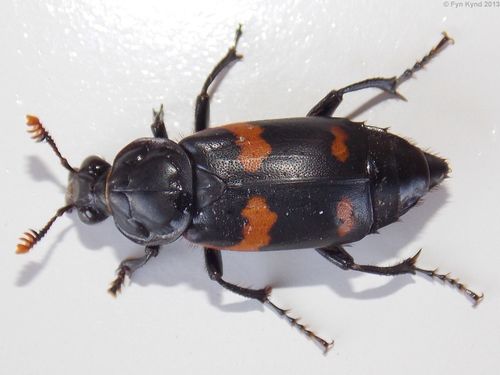
Say's Burying Beetle
Nicrophorus sayi
The Say's Burying Beetle is a striking, orange-spotted marvel of the forest floor, known for its incredible parental instincts and its vital role as nature's clean-up crew.
Quick Identification
Size
15 to 25 mm (0.6 to 1.0 inches) in length
Colors
Glossy black base with four distinct orange-red spots on the elytra (wing covers); antennae are black with bright orange-red tips.
Key Features
- Four large orange-red spots on wing covers
- Bright orange-red tips on the antennae clubs
- Smooth, hairless black pronotum
- Compact, robust body built for digging
- Large, powerful mandibles for processing carrion
When You’ll See Them
Geographic range
Where Does the Say's Burying Beetle Live?
Say’s Burying Beetle is a quintessential North American species, primarily found throughout the eastern and midwestern United States and southeastern Canada. Its territory reaches from the maritime provinces of Canada down through the Appalachian corridor and across the Great Lakes region into the Great Plains. While they favor the humid, leaf-strewn floors of temperate forests, they are frequently discovered in well-vegetated backyard habitats from New York to Minnesota and south into the Carolinas.
Basemap © OpenStreetMap contributors
Behavior
Say's Burying Beetle is one of nature's most efficient recyclers, performing the vital role of an 'undertaker' in the ecosystem. These beetles are famous for their remarkable parental care, a trait rarely seen in the insect world. Upon locating a small carcass—such as a fallen bird or a mouse—a male and female pair will work together to excavate the soil beneath it, eventually sinking the body into the ground and stripping it of fur or feathers. They then coat the carcass in antimicrobial secretions to preserve it, creating a 'brood ball' for their future offspring.
Unlike most insects that lay eggs and leave, Say's Burying Beetle parents stay to defend the carcass from competitors like flies and other beetles. They even feed their young directly through regurgitation during the early stages of larval development. While they are primarily nocturnal, they are highly sensitive to the scent of decay and can fly several miles in a single night to locate a fresh food source. To humans, they are entirely harmless and play a crucial role in disease prevention by removing decaying matter from the environment.
EverydayEarth exclusive
Camera Tips
Capturing Say's Burying Beetle on a trail camera requires a specialized setup because they are too small to trigger standard PIR (Passive Infrared) sensors. To see them in action, you should switch your camera to 'Time Lapse' mode with an interval of 1-5 minutes, or use a high-end camera with a 'Macro' focus capability and a high-sensitivity sensor. Position the camera on a small tripod or directly on the ground, angled toward a patch of clear soil or leaf litter about 12 inches away.
The most effective way to guarantee a sighting is to use a scent lure. A small piece of raw meat, such as chicken or fish, placed in a mesh container (to prevent raccoons or cats from stealing it) will act as a powerful attractant. Because Say's Burying Beetle is strictly nocturnal, ensure your camera has a high-quality infrared (no-glow) flash to avoid overexposing the beetle's reflective black shell, which can result in a 'white-out' image if the flash is too close.
The best time to attempt this is on warm, humid nights in early summer. If you are lucky, you might capture the beetle 'dragging' or burying the bait. For the best results, place your setup near the edge of a wooded area where the soil is soft enough for digging. Check your camera settings to ensure the minimum focus distance is respected, as these beetles are small and can easily appear as blurry blobs if they get too close to the lens.
Similar Species
Species that look similar or are commonly confused with Say's Burying Beetle.
Frequently Asked Questions
Record Say's Burying Beetle at your habitat
Connect a camera to start building your own species record — AI identifies every visitor automatically.