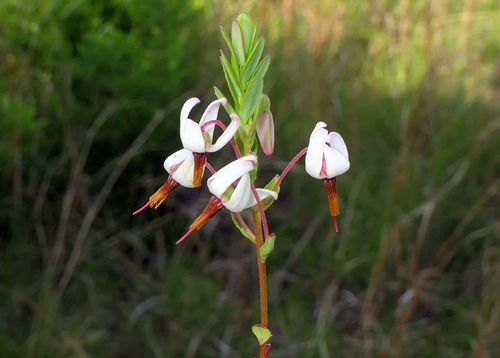
American Cranberry
Vaccinium macrocarpon
The American Cranberry is a resilient, trailing evergreen of the North American wetlands, famous for its tart crimson fruit and delicate, crane-shaped flowers. A staple of bog ecosystems, it provides critical ground cover and supports a diverse array of specialized pollinators.
Quick Identification
Size
Creeping vines up to 1-2 meters (3-6 feet) long; height 5-20 cm (2-8 inches)
Colors
Glossy dark green leaves (bronze-red in winter); white to pink flowers; deep crimson-red berries
Key Features
- Prostrate, trailing woody evergreen vines
- Nodding pinkish-white flowers with reflexed petals resembling a crane's head
- Large, globose red berries 10-20mm in diameter
- Small, leathery oval leaves with slightly silver undersides
When You’ll See Them
Geographic range
Where Does the American Cranberry Live?
This iconic berry-bearing vine is native to the temperate and boreal regions of North America. Its primary range spans from Newfoundland and the Canadian Maritimes westward to Central Ontario and Minnesota, extending southward through the Northeastern United States and down the Appalachian Mountains to North Carolina. While it is most famous for its presence in the engineered bogs of Massachusetts and Wisconsin, natural populations thrive in wild wetlands across the Great Lakes and Atlantic regions.
Basemap © OpenStreetMap contributors
Behavior
The American Cranberry is a long-lived perennial subshrub that grows as a creeping vine, creating dense mats across acidic wetland floors. Unlike most backyard plants, it thrives in low-oxygen, high-acid environments. During the spring, the vine sends up vertical branches called 'uprights,' which produce delicate, nodding flowers. These flowers have a unique structure where the petals peel back, exposing a beak-like center that requires 'buzz pollination' from specialized bees.
As an evergreen, the plant maintains its leaves throughout the year, though it undergoes a dramatic color shift. To survive the freezing temperatures of its northern range, the leaves transition from a lush summer green to a deep mahogany or bronze. This anthocyanin-driven change protects the plant's tissues from winter sun scald while it remains dormant under the snow or ice.
EverydayEarth exclusive
Camera Tips
Capturing the American Cranberry on camera requires a focus on micro-habitats. Because these plants grow very low to the ground, a standard tripod won't suffice. Use a 'ground spike' mount or a flexible-leg tripod to position your camera just 3-5 inches above the soil. To get the best clarity, aim for a 45-degree downward angle that captures both the trailing vines and the uprights where flowers and fruit develop. If you are using an AI-powered camera, set it to a wide-angle focus to ensure the creeping nature of the plant is fully documented.
The best time to film is during the flowering period in early summer. Cranberry flowers are a magnet for bumblebees and other native pollinators. Set your camera's trigger sensitivity to 'high' and use a fast shutter speed to capture the rapid wing movements of bees as they perform buzz-pollination. Since cranberries grow in wet bogs, morning dew often coats the leaves; capturing footage just after sunrise can provide stunning, high-contrast shots as the sunlight hits the water droplets and the glossy evergreen leaves.
For long-term observation, the American Cranberry is an ideal subject for time-lapse photography. Because it is a perennial that changes color with the seasons, you can set your camera to take one or two photos daily. Over several months, you will see the plant transition from vibrant green to the pinkish-white 'crane' blossoms, followed by the slow swelling and reddening of the berries, and finally the shift to winter bronze. Ensure your camera housing is extremely well-sealed, as the high-humidity environment of a bog can easily cause internal lens fogging.
Similar Species
Species that look similar or are commonly confused with American Cranberry.
Frequently Asked Questions
Record American Cranberry at your habitat
Connect a camera to start building your own species record — AI identifies every visitor automatically.