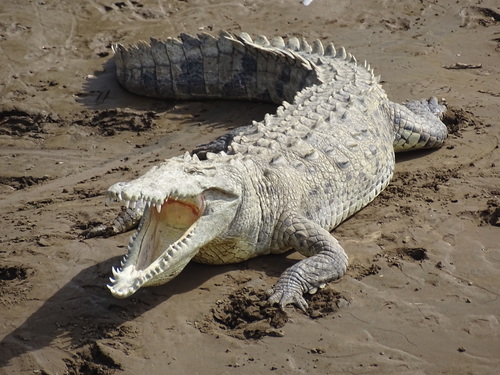
American Crocodile
Crocodylus acutus
The American Crocodile is a prehistoric icon of the Neotropics, a master of both salt and fresh water that rules the mangroves with silent grace.
Quick Identification
Size
Adults typically measure 3 to 4.6 meters (10 to 15 feet) and weigh 175 to 500 kg (400 to 1,100 lbs), though record males can reach 6 meters (20 feet).
Colors
Pale grayish-green or olive-brown upper body with a lighter cream or yellowish underside; juveniles have dark cross-banding on the body and tail.
Key Features
- Narrow, triangular snout with a distinct hump between the eyes
- Fourth lower tooth visible even when the mouth is tightly closed
- Pale grayish-green coloration unlike the darker alligator
- Thick, powerful tail with high dorsal scales
When You’ll See Them
Geographic range
Where Does the American Crocodile Live?
Native to the Neotropical regions of the Americas, the American Crocodile occupies a wide coastal range from the southern tip of Florida in the United States down through the Caribbean islands of Cuba and Jamaica. Along the mainland, they are found on both the Atlantic and Pacific coasts of Mexico, extending through Central America into South America as far as Peru and Venezuela. This species is unique for its ability to traverse open saltwater, allowing it to colonize various island chains throughout the Gulf of Mexico and the Caribbean Sea.
Basemap © OpenStreetMap contributors
Behavior
American Crocodiles are generally shy and reclusive reptiles, often retreating into the water at the first sign of human presence. They are highly efficient thermoregulators, spending long hours basking on mudflats or riverbanks with their mouths agape—a behavior known as 'gaping' that helps them release excess body heat. Unlike many other crocodilian species, they have specialized glands that allow them to process saltwater, making them exceptionally comfortable in coastal environments.
While they are primarily solitary, they can be found in loose groups in high-quality basking spots or during the breeding season. They are most active during the night, which is when they conduct the majority of their hunting. Despite their fearsome reputation, they are less aggressive toward humans than their counterparts in Africa or Australia, though they remain formidable predators that should always be observed from a safe and respectful distance.
EverydayEarth exclusive
Camera Tips
To successfully capture an American Crocodile on a trail camera, you must focus on 'transition zones'—the specific spots where they transition from water to land. Look for 'slides,' which are smooth, muddy paths on riverbanks or mangrove edges created by the crocodile's belly as it moves. Mount your camera roughly 1 to 2 feet off the ground on a sturdy tree or a deeply driven stake, as these animals are low-slung and you want to capture their profile rather than just the top of their heads.
Because crocodiles are most active during the twilight and nighttime hours, your camera's infrared (IR) capabilities are critical. Use a 'No-Glow' or 'Black IR' flash to avoid spooking the animal; while they aren't as easily startled as mammals, a bright white flash can cause them to abandon a basking spot. Set your trigger speed to the fastest possible setting and use a wide-angle lens if available, as these reptiles can be surprisingly long and you want to avoid 'tail-only' shots.
Environmental protection is a major factor when filming in crocodile territory. The salt-spray and high humidity of mangrove swamps can quickly corrode standard electronics. Use a dedicated marine-grade or weather-sealed security box for your camera. Additionally, never use food as a lure; not only is it dangerous and often illegal, but it can also condition crocodiles to associate human scents with food. Instead, aim your camera at natural basking logs or narrow canal bottlenecks where they are likely to swim through.
Similar Species
Species that look similar or are commonly confused with American Crocodile.
American Alligator
Alligators are much darker (almost black), have a blunt U-shaped snout, and lack the salt-secreting glands that allow crocodiles to thrive in saltwater.
Morelet's Crocodile
Found in Mexico and Belize, this species is smaller and has a broader snout than the American Crocodile, with more prominent dark markings on its tail.
Frequently Asked Questions
Record American Crocodile at your habitat
Connect a camera to start building your own species record — AI identifies every visitor automatically.