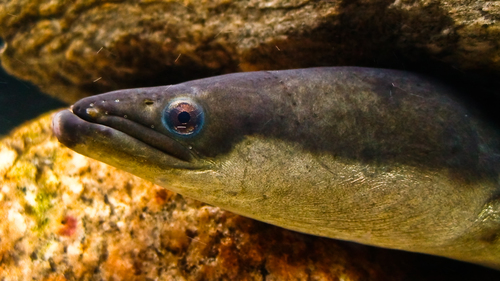
American Eel
Anguilla rostrata
A mysterious traveler of both salt and fresh water, the American Eel is a master of camouflage and one of nature's most resilient migrators.
Quick Identification
Size
Typically 1.5 to 3 feet (45–90 cm) in length, though large females can reach up to 4 feet (122 cm) and weigh over 8 lbs (3.6 kg).
Colors
Variable based on life stage; adults are usually olive-green or dark brown on the back, fading to a yellowish-gold or white belly. Migrating 'silver eels' develop a metallic sheen and dark back.
Key Features
- Snake-like body with a single continuous fin along the back and tail
- Small pectoral fins located just behind the gill openings
- Thick coating of protective mucus (slime)
- Absence of pelvic fins
When You’ll See Them
Geographic range
Where Does the American Eel Live?
Native to the eastern coast of North America, the American Eel boasts a massive range extending from the northern waters of Greenland and Canada down to the Gulf of Mexico. They are common throughout the entire United States eastern seaboard and inhabit river systems as far south as Panama and the West Indies. While they are primarily native to North and Central America, their unique migratory patterns make them one of the most widely distributed fish in the Western Hemisphere.
Basemap © OpenStreetMap contributors
Behavior
The American Eel is a fascinating catadromous species, meaning it lives most of its life in freshwater or estuarine environments but migrates thousands of miles to the Sargasso Sea in the Atlantic Ocean to spawn. They are primarily nocturnal, spending their daylight hours hiding under submerged logs, inside crevices, or buried in muddy river bottoms. During the night, they emerge to hunt, using their keen sense of smell to navigate dark or murky waters.
These eels are remarkably hardy and can survive out of water for short periods by absorbing oxygen through their skin, provided they remain moist. This allows them to occasionally crawl over wet grass or dams to reach upstream habitats. While they are solitary hunters, they are often found in high densities in healthy river systems. Their interactions with humans are mostly limited to recreational fishing or accidental sightings near docks and dams.
EverydayEarth exclusive
Camera Tips
Capturing the American Eel requires an underwater camera setup, such as a GoPro or a specialized trail camera with a waterproof housing. Position your camera in slow-moving water near structure like submerged logs, large rocks, or undercut banks where eels prefer to hide. A downward-facing angle from a fixed dock or a weighted tripod placed on a sandy riverbed works best to capture their serpentine movement.
Since American Eels are strictly nocturnal, your camera must have high-quality Infrared (IR) night vision capabilities. Standard white light flashes can startle fish and result in overexposed footage due to their reflective mucus layer. To increase your chances of a sighting, place a perforated container of 'stinky' bait—such as canned sardines, crushed clams, or oily fish scraps—directly in the camera's field of view. The scent will draw them out of hiding and keep them in frame as they investigate the source.
Pay close attention to water clarity and seasonal changes. The best footage is often captured during the late summer or fall when water levels may be lower and clearer. In the spring, watch for 'elvers' (juvenile eels) migrating upstream in large numbers near the edges of banks. Ensure your camera is securely tethered, as river currents or curious larger wildlife can easily displace lightweight equipment.
Similar Species
Species that look similar or are commonly confused with American Eel.
Frequently Asked Questions
Record American Eel at your habitat
Connect a camera to start building your own species record — AI identifies every visitor automatically.