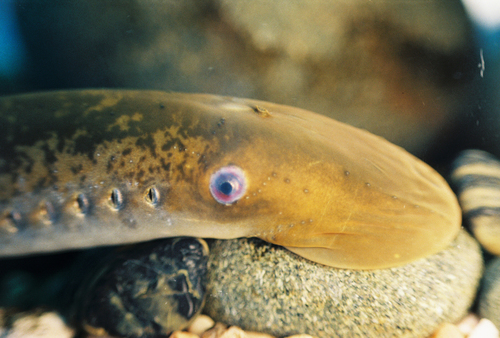
Sea Lamprey
Petromyzon marinus
The ancient, jawless 'vampire' of the waterways. The Sea Lamprey is a fascinating survivor from an era before the dinosaurs, known for its parasitic lifestyle and remarkable migratory journeys.
Quick Identification
Size
Adults typically range from 30 to 100 cm (12 to 40 inches) in length and can weigh up to 2.5 kg (5.5 lbs).
Colors
Mottled olive-brown, gray, or black on the dorsal side with a lighter, pale yellow or white belly; no scales.
Key Features
- Jawless, circular suction-cup mouth filled with concentric rows of sharp teeth
- Long, eel-like body with two distinct dorsal fins
- Seven pore-like gill openings located behind each eye
- Lack of paired fins and scales
When You’ll See Them
Geographic range
Where Does the Sea Lamprey Live?
The Sea Lamprey is native to the northern and western Atlantic Ocean, ranging from the shores of North America near Labrador down to Florida, and along the European coast from Norway to the Mediterranean. In the early 20th century, they famously bypassed natural barriers to invade the North American Great Lakes via man-made canals, where they are now considered a highly destructive invasive species. They are also found in several landlocked lakes in New York and Vermont, such as Lake Champlain.
Basemap © OpenStreetMap contributors
Behavior
The Sea Lamprey is often dubbed the 'vampire fish' due to its specialized parasitic lifestyle as an adult. They use their suction-cup mouths to latch onto larger fish, using a raspy, tooth-covered tongue to bore through the host's scales and skin to feed on blood and bodily fluids. In their native marine environments, they rarely kill their hosts, but in landlocked freshwater systems like the Great Lakes, a single lamprey can kill up to 40 pounds of fish during its lifetime.
These creatures are anadromous, meaning they spend their adult lives in the ocean or large lakes before migrating into freshwater streams to spawn. They are not strong swimmers compared to bony fish; instead, they often use their mouths to 'hop' upstream by suctioning onto rocks. After spawning in rock-constructed nests called redds, the adults die, leaving the larvae (ammocoetes) to live in the stream sediment for several years as filter feeders.
EverydayEarth exclusive
Camera Tips
Capturing a Sea Lamprey on camera requires an underwater setup, as they rarely break the surface. If you live near a tributary of the Great Lakes or an Atlantic coastal stream, the best time to deploy your camera is during the spring spawning migration. Look for shallow, fast-flowing water with gravel or cobble bottoms where lampreys gather to build their nests (redds). Place your camera in a waterproof housing, submerged and weighted to the bottom, angled slightly upward to capture the lampreys as they move over the rocks.
Because lampreys are significantly more active at night during their migration, infrared (IR) capability is a must. Avoid using bright white-light flashes, which can startle migrating fish. Instead, rely on subtle IR LEDs to capture their unique 'snakelike' swimming motion. Since they are attracted to the scent of other lampreys, placing your camera near existing nests or known 'choke points' in the stream—like small waterfalls or man-made weirs—will greatly increase your chances of a sighting.
For the most dramatic footage, try to capture their 'climbing' behavior. Lampreys will use their suction mouths to grip stones to rest or move against heavy currents. A side-view angle against a flat rock surface in a stream can provide a fascinating look at how they use their mouths as tools. Set your camera to high-frame-rate video (60fps or higher) to capture the fluid, undulating movement of their bodies in the current.
Similar Species
Species that look similar or are commonly confused with Sea Lamprey.
American Eel
Eels have true jaws and a single gill opening, whereas lampreys are jawless with seven gill pores.
Northern Brook Lamprey
Much smaller (under 6 inches) and non-parasitic; they do not feed as adults.
Chestnut Lamprey
Smaller than the Sea Lamprey and has a single continuous dorsal fin rather than two separate ones.
Frequently Asked Questions
Record Sea Lamprey at your habitat
Connect a camera to start building your own species record — AI identifies every visitor automatically.