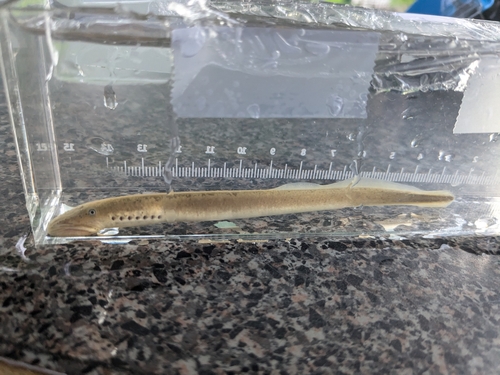
Chestnut Lamprey
Ichthyomyzon castaneus
An ancient, jawless survivor of North American rivers, the Chestnut Lamprey is a marvel of prehistoric evolution. From its parasitic adult life to its mysterious years as a riverbed larva, this unique fish plays a vital role in the health of our freshwater ecosystems.
Quick Identification
Size
15 to 38 cm (6 to 15 inches) in length; typically weighs 30 to 80 grams (1 to 2.8 oz)
Colors
Dull olive, yellowish-tan, or chestnut brown on the back and sides; belly is typically a lighter cream or silver color
Key Features
- Eel-like body lacking scales and paired fins
- Circular, sucker-like mouth filled with sharp, radiating bicuspid teeth
- Single dorsal fin that is continuous and only slightly notched
- Seven small, circular gill openings arranged in a row behind each eye
When You’ll See Them
Geographic range
Where Does the Chestnut Lamprey Live?
Native to the freshwater systems of North America, the Chestnut Lamprey is primarily found throughout the expansive Mississippi River basin and the Great Lakes drainage. Its core range extends from central Canada, including Manitoba and Ontario, southward through the Midwestern United States to the Gulf Coast drainages of Texas and Louisiana. It is a common sight in the river-rich states of Wisconsin, Minnesota, and Arkansas, though it is strictly a freshwater species and does not migrate to the ocean.
Basemap © OpenStreetMap contributors
Behavior
The Chestnut Lamprey is a primitive, jawless fish that exhibits a fascinating dual lifestyle. As adults, they are parasitic, using their specialized suction-cup mouths to attach themselves to the bodies of larger host fish like sturgeon, paddlefish, and catfish. They use a raspy, tooth-covered tongue to break the skin and feed on the host's blood and fluids. While this sounds gruesome, in a healthy ecosystem, they rarely kill their hosts, acting more like a temporary nuisance than a lethal predator.
This parasitic phase is relatively short, lasting about one year, after which the adults migrate into smaller, clear-water streams to spawn. Once they reach the spawning grounds, they move stones with their mouths to create a shallow nest called a redd. Like salmon, Chestnut Lampreys are semelparous, meaning they put all their remaining energy into reproduction and die shortly after the eggs are laid. The young, called ammocoetes, spend several years buried in river sediment as blind filter feeders before transforming into the parasitic adult form.
EverydayEarth exclusive
Camera Tips
To capture the Chestnut Lamprey on camera, you will need to utilize underwater equipment, as they are rarely visible from the surface. The best time for recording is during the spring spawning season (April to June), when adults move into shallower, clearer tributary streams. Look for gravelly riffles where the water is 1 to 3 feet deep. Secure an underwater action camera to a heavy diving weight or a flat rock to prevent it from being swept away by the current. Point the lens slightly downstream to catch the lampreys as they struggle against the current or move stones to build their nests.
Because river water can be turbid, choose a day after a period of no rain when the water clarity is at its peak. Natural sunlight is your best friend; try to position the camera in a spot that receives direct overhead sun between 10 AM and 2 PM. The Chestnut Lamprey’s skin is non-reflective and brownish, which can make it disappear against a rocky background, so a high-contrast setting or 4K resolution is helpful for picking out detail.
If you are using a trail camera with an external waterproof housing, set it to record short video clips (15-30 seconds) rather than still photos. The unique, undulating swimming motion of the lamprey is its most identifying characteristic and is best captured in motion. Avoid using high-intensity artificial lights at night, as this can spook both the lampreys and their potential host fish. Instead, rely on high-ISO settings for low-light morning or evening shots.
Similar Species
Species that look similar or are commonly confused with Chestnut Lamprey.
Silver Lamprey
Silver Lampreys usually have single-pointed (unicuspid) teeth in the circumoral row, whereas Chestnut Lampreys have two-pointed (bicuspid) teeth.
Sea Lamprey
Much larger (up to 3 feet) with two separate dorsal fins and a more mottled, dark grey-to-black appearance.
Northern Brook Lamprey
This species is non-parasitic as an adult and is significantly smaller, usually reaching only 6 inches in length.
Frequently Asked Questions
Record Chestnut Lamprey at your habitat
Connect a camera to start building your own species record — AI identifies every visitor automatically.