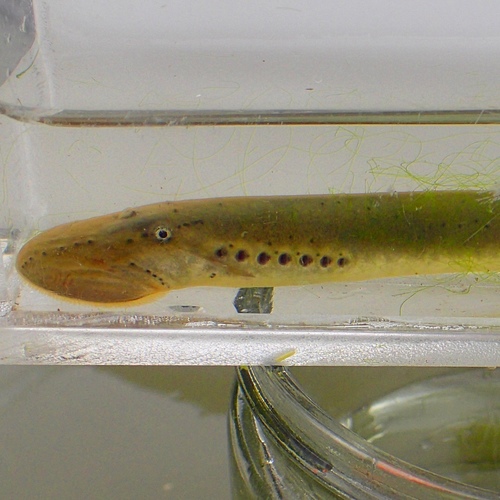
Silver Lamprey
Ichthyomyzon unicuspis
The silver lamprey is a remarkable 'living fossil' that has inhabited North American waterways for millions of years. This native jawless fish offers a unique glimpse into the ancient history of aquatic life.
Quick Identification
Size
15–39 cm (6–15 inches) in length; weight typically ranges from 15–150 grams (0.5–5.3 oz)
Colors
Silvery-grey to tan or light blue-grey on the dorsal side; belly is white or pale yellowish; fins are often yellow-tinted
Key Features
- Suction-cup mouth with unicuspid (single-pointed) teeth
- Long, eel-like body without paired fins
- Single, continuous dorsal fin that is not notched
- Seven circular gill openings on each side
When You’ll See Them
Geographic range
Where Does the Silver Lamprey Live?
The silver lamprey is a native inhabitant of North America, found throughout the freshwater systems of the northern and central United States and southern Canada. Its core range includes the Great Lakes basin and the St. Lawrence River, extending westward through the Mississippi and Ohio River drainages to parts of Manitoba and Nebraska. While they are occasionally found as far south as Tennessee, they are most prevalent in the cool, interior waterways of the Midwest and Northeast.
Basemap © OpenStreetMap contributors
Behavior
The silver lamprey is a parasitic, jawless fish that spends its adult life attached to larger host fish. Using its specialized suction-cup mouth and rasping tongue, it creates a small wound to feed on the blood and body fluids of its host. Unlike the invasive sea lamprey, the native silver lamprey has evolved alongside North American fish and rarely kills its host in healthy ecosystems.
As nocturnal creatures, they are most active under the cover of darkness, often moving between feeding grounds and resting spots. During the spring, adults undertake a significant migration upstream to clear, gravelly tributaries for spawning. Once they reach the spawning grounds, they use their mouths to move stones and create a nest (redd) before eventually dying after the eggs are laid.
EverydayEarth exclusive
Camera Tips
Capturing the silver lamprey on camera is a rewarding challenge that requires a specialized underwater setup. Because they are aquatic and largely nocturnal, you should use a waterproof trail camera or an action camera with high-quality infrared (IR) night vision. The best time to see them is during their spring spawning run, typically from May to June. Position your camera in shallow, gravel-bottomed riffles of small to medium-sized streams where they gather to build nests.
For the most stable footage, mount your camera to a weighted base or a heavy rock using a specialized strap. Place the camera about 12-18 inches from the bottom, angled slightly upward toward a clear patch of gravel. This setup allows you to witness their unique nest-building behavior, where they use their suction mouths to haul stones. Since they are light-sensitive, avoid using white LED flashes; 'no-glow' or 940nm infrared is much better for observing their natural movements without scaring them away.
During the rest of the year, you might catch a silver lamprey 'hitchhiking' on a host fish. If you have a dock or a permanent underwater camera in a lake, focus your lens on areas where large fish like walleye or northern pike congregate. Look for a long, thin shape attached to the side or belly of these larger fish. To get the best clarity in murky river water, set your camera to record high-definition video (1080p or higher) with a high frame rate to capture the lamprey's distinct, undulating swimming pattern.
Similar Species
Species that look similar or are commonly confused with Silver Lamprey.
Sea Lamprey
Much larger (up to 40 inches) with a notched dorsal fin and mottled, dark skin compared to the silver lamprey's uniform color.
American Brook Lamprey
Non-parasitic and smaller; their teeth are poorly developed and they do not attach to other fish as adults.
Chestnut Lamprey
Very similar in appearance but has bicuspid (two-pointed) teeth in certain areas of the mouth disc, whereas the silver lamprey's teeth are unicuspid.
Frequently Asked Questions
Record Silver Lamprey at your habitat
Connect a camera to start building your own species record — AI identifies every visitor automatically.