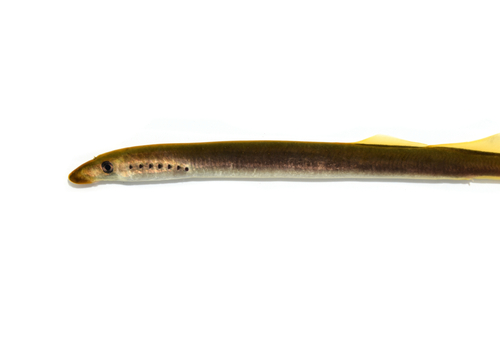
American Brook Lamprey
Lethenteron appendix
A harmless and ancient resident of North American streams, the American Brook Lamprey is a master of the hidden world. Unlike its parasitic cousins, this 'living fossil' spends years as a quiet filter-feeder before emerging for a spectacular spring spawning ritual.
Quick Identification
Size
Typically 13 to 20 cm (5 to 8 inches), though some individuals reach 30 cm (12 inches).
Colors
Dark olive, slate, or grayish-brown on the back and sides; belly is silvery-white or pale yellow. Fins are translucent with a yellowish hue.
Key Features
- Long, eel-like body without scales
- Disk-shaped mouth with small, blunt, poorly developed teeth
- Seven distinct pore-like gill openings in a row behind the eye
- Single dorsal fin with a deep notch separating it into two lobes
When You’ll See Them
Geographic range
Where Does the American Brook Lamprey Live?
Where Does the American Brook Lamprey Live? This species is native to the temperate freshwater systems of North America. Its primary range is concentrated around the Great Lakes and St. Lawrence River basins, extending through the Mississippi and Ohio River drainages. You can find them across a broad swath of the eastern and central United States, from the Appalachian Mountains westward to Minnesota and south into parts of Arkansas and Alabama. They are also widely distributed across southeastern Canada, particularly in Ontario and Quebec.
Basemap © OpenStreetMap contributors
Behavior
The American Brook Lamprey is a non-parasitic species that spends the vast majority of its life as a blind, worm-like larva called an ammocoete. During this stage, which can last up to seven years, they live buried in the soft silt and organic debris of stream bottoms. They are rarely seen by humans during this time, as they only emerge if their habitat is severely disturbed or when they are ready to begin their final transformation.
Metamorphosis into adulthood occurs in late summer or fall, during which they develop eyes and a disk-like mouth. Interestingly, as they become adults, their digestive systems degenerate, and they stop eating entirely. They spend their final winter hiding in the substrate before emerging in the spring to spawn. During spawning, they become highly social and can be seen in groups in shallow riffles, using their mouths to move small stones to create communal nests.
EverydayEarth exclusive
Camera Tips
Capturing the American Brook Lamprey requires an underwater approach, as they rarely break the surface. The best time to deploy your camera is during the spring spawning window when water temperatures rise above 10°C (50°F). Seek out shallow riffles—areas where water flows quickly over gravel and cobble. Look for small depressions in the gravel, which are signs of active nest-building. Place your camera on a weighted mount or a low-profile stream tripod, positioning the lens just a few inches above the stream bed facing the upstream side of the nest.
Since these fish are most active in the spring when snowmelt or rain can make water murky, proximity is key. Set your camera's focus range to 'macro' if available, or place it within 12 inches of the gravel pit to ensure clear details of their movements. High frame rate settings (60fps or higher) are essential for this species; their spawning behavior involves rapid, serpentine wiggling and stone-moving that can appear blurry at standard frame rates.
While you cannot bait a non-feeding adult lamprey, you can increase your chances of a capture by 'prepping' a site. Gently clear a small 12-inch circle of silt from a gravelly area in a slow-moving section of a riffle. This mimics the start of a nest and may attract a group of lampreys to finish the job right in front of your lens. Midday sun is your best friend for lighting, as it penetrates the water best; try to avoid placing cameras in heavy shadows if you want to see the subtle olive and gold coloration of the fish.
Similar Species
Species that look similar or are commonly confused with American Brook Lamprey.
Sea Lamprey
Much larger (up to 3 feet long) and parasitic, with two separate dorsal fins and sharper, more numerous teeth.
Least Brook Lamprey
Smaller in size and has a dorsal fin that is continuous or only slightly notched rather than deeply divided.
Chestnut Lamprey
A parasitic species with a continuous dorsal fin and much more prominent, sharp teeth for attaching to host fish.
Frequently Asked Questions
Record American Brook Lamprey at your habitat
Connect a camera to start building your own species record — AI identifies every visitor automatically.