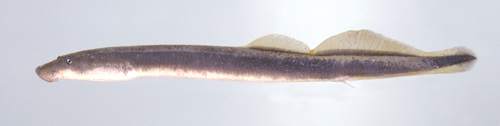
Least Brook Lamprey
Lampetra aepyptera
Meet the Least Brook Lamprey, a harmless, ancient resident of North American streams that spends years hidden in the mud before emerging for a spectacular spring dance.
Quick Identification
Size
7.5 to 18 cm (3 to 7 inches) in length; weight is negligible, typically under 15 grams
Colors
Olive-green to dark tan on the back and sides, transitioning to a pale yellow or silvery-white belly; fins are usually clear or slightly dusky
Key Features
- Slender, eel-like body without scales
- Jawless, circular sucking mouth
- Single continuous dorsal fin with a distinct notch
- Seven small, circular gill openings aligned behind each eye
When You’ll See Them
Geographic range
Where Does the Least Brook Lamprey Live?
Native to the North American continent, the Least Brook Lamprey is primarily found across the eastern and central United States. Its core range spans the Mississippi River basin and the Ohio River valley, reaching from the Gulf Coast states northward into Pennsylvania and west toward Missouri. Engaging and elusive, they also occupy a disconnected range along the Atlantic slope, appearing in coastal plain streams from Maryland down to North Carolina.
Basemap © OpenStreetMap contributors
Behavior
The Least Brook Lamprey is a fascinating 'living fossil' that spends the vast majority of its life in a larval stage known as an ammocoete. During this period, which lasts between three and seven years, they live buried in the soft silt and organic debris of stream bottoms. They are sedentary filter feeders, playing a crucial role in the ecosystem by processing nutrients and cleaning the substrate. Unlike their more infamous relatives, this species is entirely non-parasitic and never attaches to other fish.
Upon reaching maturity in late summer or fall, they undergo a dramatic metamorphosis where they develop eyes and a functional (though non-feeding) mouth. The adults emerge in early spring for a brief, high-energy spawning period. They are social during this time, often seen in small groups congregating in shallow, rocky riffles. After working together to move stones and create a communal nest, they spawn and complete their life cycle, dying shortly thereafter.
EverydayEarth exclusive
Camera Tips
To capture the Least Brook Lamprey on camera, you must go underwater. These fish are almost never visible from the surface except during the peak of spring spawning. Use a waterproof action camera or a trail camera with a high-quality underwater housing. Because these lampreys are small and move with a quick, undulating motion, a camera capable of 60 frames per second (fps) is ideal for capturing clear footage of their 'swimming' behavior.
Placement is everything. Scout your local stream in early spring for shallow 'riffles'—areas where the water ripples over gravel and small stones. Look for groups of lampreys congregating to move stones with their mouths. Place your camera on a weighted plate or a low-profile tripod directly on the stream bed, about 6 to 12 inches away from the nest site. Angle the lens slightly upward toward the light to highlight the translucent quality of their fins and the texture of their skin.
Since lampreys are sensitive to vibration and shadows, set your camera to record in 2-3 minute intervals and leave the area. They are most active when the water temperature hits 10-15°C (50-60°F). Avoid using bright external white lights at night, as this can startle them; instead, rely on high-quality natural light during mid-day for the best color reproduction. In clearer water, you can capture the fascinating communal effort of multiple individuals working on a single nest.
Similar Species
Species that look similar or are commonly confused with Least Brook Lamprey.
American Brook Lamprey
Very similar, but the American Brook Lamprey has two distinct dorsal fins, whereas the Least Brook Lamprey has one fin with a deep notch.
Sea Lamprey
Much larger (up to 20 inches) and parasitic with a mottled skin pattern, compared to the small, uniform color of the Least Brook Lamprey.
American Eel
Eels have true jaws, scales (though tiny), and a single gill slit, unlike the jawless, multi-gilled lamprey.
Frequently Asked Questions
Record Least Brook Lamprey at your habitat
Connect a camera to start building your own species record — AI identifies every visitor automatically.