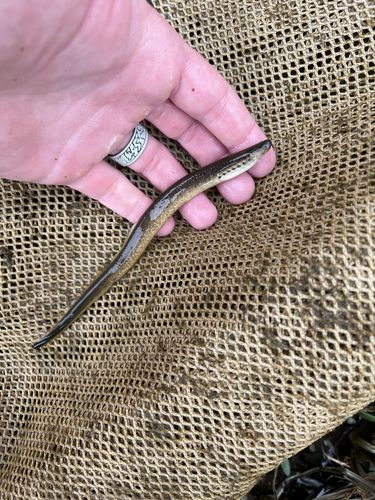
Northern Brook Lamprey
Ichthyomyzon fossor
A hidden gem of North American waterways, the Northern Brook Lamprey is a harmless, fascinating fish that spends years tucked away in the stream bed before a brief, dramatic appearance to spawn.
Quick Identification
Size
9–16 cm (3.5–6.3 inches) in length; weighs approximately 5–15 grams (0.2–0.5 ounces)
Colors
Dorsally olive-brown to slate-gray; belly is pale yellow, white, or silvery; dark tinting on the dorsal fin
Key Features
- Continuous dorsal fin without a notch
- Disc-like mouth with small, blunt teeth
- Seven circular gill openings arranged in a line behind the eye
When You’ll See Them
Geographic range
Where Does the Northern Brook Lamprey Live?
Native to the temperate freshwater systems of North America, the Northern Brook Lamprey is primarily concentrated within the Great Lakes basin and the upper Mississippi River drainage. Its core range extends across the northeastern United States and southeastern Canada, including significant populations in Ontario, Quebec, New York, and Michigan, reaching as far south as the Ohio River valley in Kentucky and West Virginia. While its distribution is widespread within these regions, it is highly dependent on pristine, unpolluted waterways, making it a sensitive indicator of local stream health.
Basemap © OpenStreetMap contributors
Behavior
The Northern Brook Lamprey is a non-parasitic species, distinguishing it from its more infamous, blood-sucking relatives. It spends the vast majority of its life—up to seven years—in a larval stage known as an ammocoete. During this time, it remains almost entirely sedentary, burrowed into the soft silt and sand of stream bottoms, where it acts as a vital part of the ecosystem by recycling nutrients.
Upon reaching maturity, the lamprey undergoes a dramatic metamorphosis into an adult, which usually occurs in late summer or autumn. Interestingly, the adults do not eat; their digestive systems actually degenerate, and they live only a few months longer to spawn. During the spring spawning season, they become more active, moving into swifter, gravel-bottomed waters. They are generally solitary as larvae but can be seen in small groups while building nests or spawning in the riffles of clear brooks.
EverydayEarth exclusive
Camera Tips
Capturing the Northern Brook Lamprey on camera requires a specialized approach since they are almost exclusively aquatic and often subterranean. For the best results, use a waterproof trail camera or an action camera with a specialized underwater housing. During the spring spawning season (late April to early June), place your camera in shallow riffles where the water is only 10-30 cm deep. These are the gravelly areas where adults emerge to build nests. Mounting the camera on a weighted base or a low-profile underwater tripod is essential to prevent it from being swept away by the current.
Because these lampreys are most active at night, ensure your camera has high-quality infrared (IR) capabilities. Standard white flash can be too reflective underwater and may spook the fish. Position the lens at a 45-degree angle to the stream bed to capture the characteristic 'rock-moving' behavior adults exhibit when building nests. Since the larvae are buried, you won't see them on camera unless you are lucky enough to catch one transitioning to the spawning grounds.
Water clarity is your biggest hurdle. Plan your 'camera trap' after a few days of dry weather when the sediment has settled. If you are monitoring a backyard stream, avoid placing the camera near areas of high turbulence or bubbles, which can trigger the motion sensor and fill your SD card with 'blank' footage of moving water. Using a camera with a high-sensitivity sensor is key, as the subtle movements of a 6-inch lamprey against a dark stream bed can be difficult for standard AI to detect.
Similar Species
Species that look similar or are commonly confused with Northern Brook Lamprey.
Silver Lamprey
The Silver Lamprey is parasitic, grows larger, and has sharp teeth for attaching to hosts.
American Brook Lamprey
This species has a deeply notched dorsal fin, creating two distinct lobes, whereas the Northern Brook Lamprey's fin is continuous.
Sea Lamprey
Much larger (up to 20+ inches) with a highly aggressive parasitic mouth; Sea Lampreys have two widely separated dorsal fins.
Frequently Asked Questions
Record Northern Brook Lamprey at your habitat
Connect a camera to start building your own species record — AI identifies every visitor automatically.