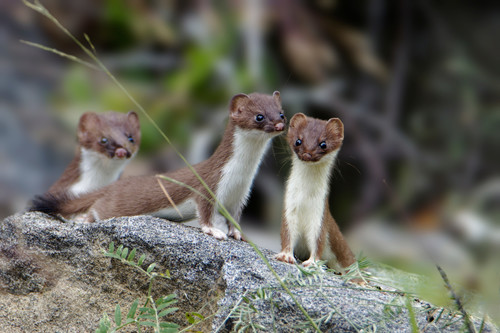
American Ermine
Mustela richardsonii
The American Ermine is a master of transformation and a pint-sized powerhouse of the North American woods. Known for its snowy winter coat and relentless hunting spirit, this charismatic weasel is a favorite for backyard trail camera enthusiasts.
Quick Identification
Size
Length: 19–34 cm (7.5–13.5 in); Weight: 45–170 g (1.6–6 oz). Males are significantly larger than females.
Colors
Brown upperparts with creamy-white underparts in summer; entirely white in winter. The tail always has a distinct black tip.
Key Features
- Distinct black-tipped tail year-round
- Elongated, slender body with short legs
- Seasonal coat change from chocolate brown to snowy white
- Triangular head with small, rounded ears
When You’ll See Them
Geographic range
Where Does the American Ermine Live?
The American Ermine is native to the North American continent, where it maintains a massive footprint across the northern latitudes. It is found throughout nearly all of Canada and Alaska, stretching southward into the northern United States, including the Great Lakes region, the Pacific Northwest, and New England. Unlike its European cousins, this species is a true specialist of the Nearctic realm, thriving in both the frigid tundra and the dense temperate forests of the American core.
Basemap © OpenStreetMap contributors
Behavior
The American Ermine is a high-energy dynamo, driven by a metabolism so fast it must consume nearly half its body weight every day. These solitary mammals are relentless hunters, using their slender bodies to pursue rodents directly into their burrows. They are known for the 'weasel war dance,' a series of hops, twists, and lunges used to confuse prey or express excitement.
While they are primarily solitary and territorial, ermines are remarkably curious and may occasionally investigate human structures if prey is abundant. They are largely nocturnal or crepuscular to avoid larger predators like owls and hawks, but their need for frequent meals means they can be seen hunting at any hour of the day or night.
EverydayEarth exclusive
Camera Tips
Capturing an American Ermine on camera requires precision because of their incredible speed and small size. Position your camera very low to the ground—no higher than 6 to 12 inches—and aim it at natural 'funnels' like gaps in stone walls, hollow logs, or the base of woodpiles. These are the highways ermines use to stay hidden from overhead predators while searching for mice.
To keep an ermine in the frame long enough for a good shot, use a lure. A small amount of oily fish like sardines or even a cotton ball soaked in valerian root extract or commercial weasel lure can work wonders. Place the lure behind a small obstacle like a stick so the ermine has to pause and investigate, giving your camera's trigger time to fire. Ensure your PIR (motion sensor) sensitivity is set to 'High' to catch their lightning-fast movements.
In winter, the ermine's white coat can easily be 'blown out' or overexposed by night-vision infrared flashes against the snow. If your camera allows, turn down the flash intensity or use 'invisible' 940nm LEDs to prevent scaring the animal or washing out the detail of its fur. Video mode is often superior to stills for this species, as it captures their unique, undulating gait and inquisitive 'periscoping' behavior when they stand on their hind legs.
Similar Species
Species that look similar or are commonly confused with American Ermine.
Long-tailed Weasel
Noticeably larger with a much longer tail (40-70% of body length) and a more yellowish belly in summer.
Least Weasel
Much smaller and lacks the black tip on the tail, which is the most reliable field mark.
Mink
Much larger and darker (dark brown to black) with a white patch only on the chin, and they lack the distinct color-blocked belly.
Frequently Asked Questions
Record American Ermine at your habitat
Connect a camera to start building your own species record — AI identifies every visitor automatically.