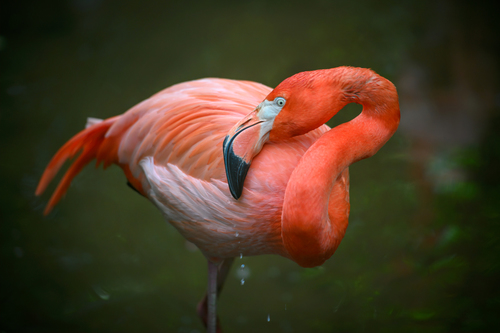
American Flamingo
Phoenicopterus ruber
The American Flamingo is a masterpiece of evolution, sporting brilliant coral plumage and a specialized bill for filtering the salt-rich waters of the Caribbean. These social icons bring a splash of neon color to the coastal mudflats and lagoons they call home.
Quick Identification
Size
Height 120-145 cm (47-57 in), wingspan 140-165 cm (55-65 in), weight 2.2-2.8 kg (4.8-6.2 lbs)
Colors
Vibrant reddish-pink to orange-pink plumage; black primary and secondary flight feathers; pink bill with a prominent black tip; pale yellow eyes.
Key Features
- Bright reddish-pink plumage
- Large, downward-hooked bill with black tip
- Extremely long, thin pink legs with webbed feet
- Long neck usually held in an S-curve
When You’ll See Them
Geographic range
Where Does the American Flamingo Live?
The American Flamingo is primarily native to the Caribbean Basin, with significant populations in the Bahamas, Cuba, and the Yucatán Peninsula of Mexico. Their range extends along the northern coast of South America into Venezuela and Colombia, and they maintain a unique, isolated resident population in the Galápagos Islands. In the United States, they are most frequently sighted in South Florida, where they were once native and are currently seeing a natural population resurgence, with occasional storm-driven vagrants appearing as far north as the mid-Atlantic states.
Basemap © OpenStreetMap contributors
Behavior
American Flamingos are highly social birds that thrive in colonies consisting of thousands of individuals. They are famous for their ritualized group displays, which include synchronized movements like "head flagging" (turning heads side-to-side in unison) and "wing saluting" (flashing their black flight feathers). These displays are essential for coordinating the breeding cycle of the entire colony. Despite their delicate appearance, they are hardy birds capable of living in extremely salty and alkaline environments that would be toxic to most other animals.
While they spend much of their day feeding or preening their feathers to maintain waterproofing, they are also strong flyers. They often travel in large V-formations at night to move between feeding grounds or to find new nesting sites. When interacting with humans, they are generally shy and will take flight if approached too closely, making long-distance observation or remote cameras the best way to watch them. They are vocal birds, producing a series of loud, goose-like honks and grunts to communicate within the flock.
EverydayEarth exclusive
Camera Tips
Capturing American Flamingos on camera requires a strategy focused on their height and habitat. Because these birds can stand nearly five feet tall, avoid placing your camera at ground level. Instead, mount your camera approximately 3 to 4 feet high on a sturdy stake or a PVC pipe driven into the mud. Angle the lens slightly downward to capture the bird's unique "upside-down" feeding behavior in the shallow water. This height ensures you get the full body and the striking black flight feathers when they stretch their wings.
Standard birdseed won't work for flamingos; they are drawn to specific environmental conditions. Look for shallow, brackish water (less than 12 inches deep) with visible organic activity. If you are on private property with a lagoon, avoid clearing out the algae and mud, as this is their primary foraging ground. Setting up your camera near a known "loafing" spot—areas where birds stand on one leg to rest—is more effective than placing it in deep water where they only pass through.
Lighting is your biggest challenge and your best friend. The vibrant pink of the American Flamingo can become "blown out" in harsh midday tropical sun. Set your camera to underexpose slightly if possible, or focus your capture windows for the early morning or late afternoon when the golden hour light makes their plumage glow. Use a high-speed trigger (0.3 seconds or faster) because while they look stationary, their neck movements are lightning-fast when filtering water or preening.
Lastly, remember that the environments flamingos love are incredibly corrosive. Salt spray and high humidity will destroy electronics quickly. Use a high-quality waterproof housing and consider applying a thin layer of silicone grease to the camera's rubber seals. Check the lens weekly to wipe away salt crust, which can blur your images and make the AI struggle to identify the species. If your camera allows for it, record 10-20 second video clips rather than stills to capture the social honking and rhythmic feeding dances.
Similar Species
Species that look similar or are commonly confused with American Flamingo.
Roseate Spoonbill
Much smaller with a flat, spoon-shaped bill and a partially bald head; lacks the flamingo's extremely long neck.
Greater Flamingo
Very similar in size but has much paler, almost white plumage with only light pink accents, compared to the deep reddish-pink of the American species.
Wood Stork
Similar in height and leg length but has white plumage with black wing tips and a featherless, dark grey head and neck.
Frequently Asked Questions
Record American Flamingo at your habitat
Connect a camera to start building your own species record — AI identifies every visitor automatically.