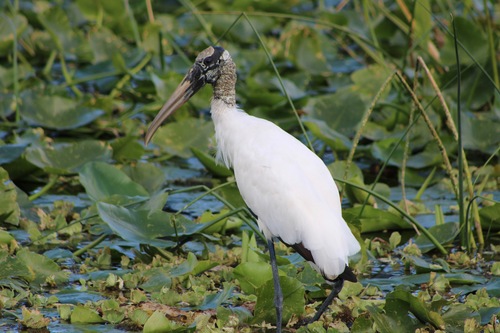
Wood Stork
Mycteria americana
Often called the 'Ironhead,' the Wood Stork is a living link to the prehistoric past. As the only stork species that breeds in North America, its unique tactile hunting style and massive wingspan make it a crown jewel for any backyard wildlife enthusiast.
Quick Identification
Size
Length: 33–45 in (85–115 cm); Wingspan: 59–71 in (150–180 cm); Weight: 4.5–7.5 lbs (2–3.4 kg)
Colors
Pure white body plumage; flight feathers and tail are jet black with a greenish-purple sheen; head and neck are featherless and dark, scaly grey.
Key Features
- Featherless, scaly dark grey head and neck
- Thick, heavy bill that curves slightly downward at the tip
- Long black legs with distinctive pinkish-orange toes
- Broad white wings with a striking black border visible in flight
When You’ll See Them
Sightings on EverydayEarth
Jun 25, 2026
A bustling rookery is active in a large cypress tree. A Tricolored Heron perches centrally, while a Great Egret is visible on the right. Several Wood Storks are scattered throughout the branches, and the pink plumage of a Roseate Spoonbill can be seen in the lower foliage. The birds are vocalizing and shifting positions within the nesting colony.
Jun 25, 2026
A diverse colony of wading birds is gathered in the branches of a large tree overlooking the swamp. Several White Ibises and Great Egrets are perched at various heights, engaged in preening and shifting their positions. In the lower-left foreground, a Roseate Spoonbill is visible, adding a splash of pink to the scene. A Wood Stork makes a brief appearance as it flies through the center of the frame from right to left.
Jun 25, 2026
A diverse colony of wading birds is seen roosting in a large, weathered tree at dusk. Several Great Egrets are perched on the higher branches, with one on the left actively preening its feathers and stretching a wing. Wood Storks and White Ibises are scattered throughout the mid-level branches, while a group of Roseate Spoonbills is visible in the lower-left foreground, their pink feathers standing out against the darkening foliage.
Jun 23, 2026
A group of Roseate Spoonbills is seen perched throughout the branches of a cypress tree in a busy rookery. The birds are active, preening their bright pink feathers and shifting positions on the limbs. In the upper portion of the canopy, a Wood Stork is also visible, resting quietly amidst the foliage.
Jun 23, 2026
A group of diverse wading birds is active along the muddy bank and shallow water of the swamp. A Wood Stork and a pale Roseate Spoonbill are foraging close together in the center, while several Great Egrets stand nearby, watching for prey in the water. The birds move with steady, purposeful steps through the shallows.
Jun 12, 2026
Several Wood Storks are perched deep within the dense foliage of a swamp rookery at night. The birds are mostly stationary, with one individual in the lower center of the frame occasionally shifting its weight and adjusting its head while roosting.
Behavior
The Wood Stork is a highly social bird that often travels and feeds in large flocks. Unlike many other wading birds that hunt by sight, the Wood Stork is a tactile feeder. It stands in shallow water and moves its open bill through the water until it touches a fish, at which point its beak snaps shut with one of the fastest reflexes in the vertebrate world—taking as little as 25 milliseconds.
In the air, these birds are magnificent to watch. They are masters of soaring, using warm air thermals to reach great heights, sometimes traveling miles from their nesting colonies to find productive foraging grounds. While they are generally quiet birds, you might hear a low croak or the clattering of their bills during the breeding season when they congregate in cypress or mangrove swamps.
EverydayEarth exclusive
Camera Tips
Capturing a Wood Stork on your EverydayEarth camera requires focusing on their unique relationship with water. Because they are heavy birds, they prefer to land and take off in open, unobstructed areas. Place your camera near the edge of a retention pond, marshy shoreline, or flooded field. Aim the lens roughly 12-18 inches off the ground to capture their fascinating 'foot-stirring' behavior, where they use their bright pink toes to startle fish out of the mud and into their open bills.
Lighting is your biggest challenge with Wood Storks. Their brilliant white feathers can easily 'blow out' or lose detail in bright midday sun, appearing as a featureless white blob on camera. Set your camera to capture high-quality images during the 'Golden Hours' (just after sunrise or before sunset) when the light is softer. If your camera allows for exposure adjustment, consider underexposing slightly to preserve the texture of their feathers.
In a backyard setting, you don't necessarily need a lure, but these birds are highly attracted to receding water levels where fish become concentrated. If you have a property with a seasonal pond or swale, the Wood Stork is most likely to appear as the water dries up. Because they are large and move relatively slowly while foraging, use a standard motion trigger delay of 5-10 seconds between shots to ensure you get a variety of poses without filling your SD card with the same feeding sequence.
Lastly, consider the 'Ironhead' profile. To get that iconic prehistoric look, try to position your camera so it captures the bird in profile. Their scaly, featherless heads provide a wonderful texture contrast against the water. If your camera is near a nesting colony (usually over water in tall trees), aim it at clear flight paths where you can capture their massive wingspan as they return with nesting materials.
Similar Species
Species that look similar or are commonly confused with Wood Stork.
American White Pelican
Much heavier body with a feathered head and a massive orange pouch bill; lacks the stork's long, thin legs.
Great Egret
Completely white plumage including the head and neck; has a straight, yellow dagger-like bill.
White Ibis
Significantly smaller with a bright red/pink face and a much thinner, more dramatically curved red bill.
Frequently Asked Questions
Record Wood Stork at your habitat
Connect a camera to start building your own species record — AI identifies every visitor automatically.