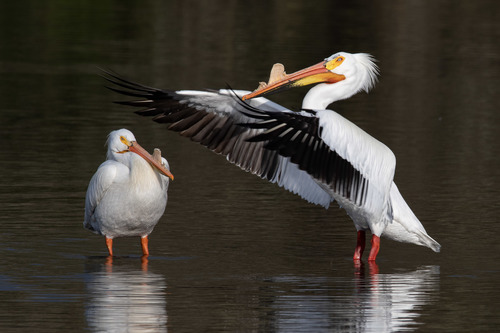
American White Pelican
Pelecanus erythrorhynchos
The American White Pelican is a master of the air and water, famous for its massive wingspan and incredible cooperative hunting techniques. These snowy-white giants are a breathtaking addition to any waterside landscape.
Quick Identification
Size
Length: 50-70 in (127-178 cm); Wingspan: 95-120 in (240-305 cm); Weight: 11-20 lbs (5-9 kg)
Colors
Brilliant white plumage with black primary and secondary flight feathers; bright orange bill, pouch, and legs; eyes are typically pale.
Key Features
- Massive orange bill with expandable throat pouch
- Huge white wings with black tips visible in flight
- Large fibrous 'horn' on upper mandible during breeding
- Slow, rhythmic wingbeats and graceful soaring
When You’ll See Them
Sightings on EverydayEarth
Apr 16, 2026
A group of American White Pelicans is gathered on a small island of dry vegetation in the middle of a lake. Several individuals are preening or adjusting their positions. In the surrounding water, a large flock of smaller, dark birds is swimming and diving, likely foraging for food in the shallow water.
Apr 10, 2026
A large flock of American White Pelicans is gathered on a narrow island in the middle of the river, mostly resting and preening. In the foreground, several Canada Geese can be seen swimming, while other small groups of waterfowl are scattered across the water under an overcast sky.
Geographic range
Where Does the American White Pelican Live?
Native to North America, the American White Pelican occupies a vast geographic range that shifts significantly with the seasons. They primarily breed in the interior of the continent, from the prairie provinces of Canada down through the Great Plains and the Rocky Mountain states. As winter approaches, these migratory giants head south to find open water, blanketing the coasts of California, the Gulf of Mexico, Florida, and south through Mexico into Central America. While they are most common in the western and central United States, they are increasingly spotted in eastern wetlands during migration.
Basemap © OpenStreetMap contributors
Behavior
American White Pelicans are highly social and intelligent birds that exhibit fascinating cooperative behaviors. Unlike many other pelican species, they do not plunge-dive from great heights. Instead, they hunt in groups, swimming together in a synchronized line or semi-circle to drive schools of fish into shallow water where they can be easily scooped up. This team-based foraging strategy is a marvel of avian coordination.
On land and water, they are relatively quiet, but in the air, they are master gliders. They often travel in large V-formations or long lines, using thermal updrafts to soar to incredible heights with minimal effort. While they are generally wary of humans and prefer remote nesting sites on islands, they have become increasingly common sights in suburban wetlands, parks, and coastal areas during their migratory stopovers.
EverydayEarth exclusive
Camera Tips
Capturing the American White Pelican requires strategic camera placement near water bodies. Since these birds are significantly larger than your average backyard visitor, mount your camera at a height of about 2 to 3 feet, ideally on a dock piling or a stable tripod near a shoreline. Angle the lens slightly upward if you are positioned close to the water to ensure you capture their full 9-foot wingspan when they take off or land.
Because the American White Pelican is brilliantly white, they can easily 'blow out' or appear as a featureless white blob in direct sunlight. If your AI camera settings allow for exposure compensation, set it to -1.0 or -2.0 during midday. This will help preserve the intricate texture of their feathers and the details of the orange bill. The best shots usually occur during the 'Golden Hour'—shortly after sunrise or before sunset—when the light is softer and their cooperative fishing behavior is most active.
For the best action shots, look for 'pinch points' in local waterways, such as narrow channels between ponds or areas near small dams. These are natural funnels where pelicans gather to herd fish. Use a high-speed trigger setting or video mode to capture the group dynamics of their feeding. If you have a backyard lake or pond, avoid using artificial lures; instead, ensure the water remains healthy for native fish, which will naturally attract these magnificent birds over time.
Similar Species
Species that look similar or are commonly confused with American White Pelican.
Brown Pelican
Much smaller with dark brown plumage; unique plunge-diving hunting style from the air.
Wood Stork
Smaller with a featherless black head and a downward-curved bill; lacks the expandable throat pouch.
Trumpeter Swan
Large and white, but has a much shorter, black bill and lacks the black flight feathers of the pelican.
Frequently Asked Questions
Record American White Pelican at your habitat
Connect a camera to start building your own species record — AI identifies every visitor automatically.