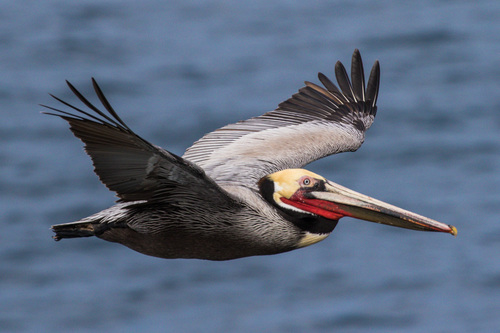
Brown Pelican
Pelecanus occidentalis
Witness the dramatic plunge-dive of the Brown Pelican, a coastal icon known for its massive bill and prehistoric silhouette. From sun-drenched piers to the crashing surf, these social giants are the undisputed masters of the American shoreline.
Quick Identification
Size
Length: 1–1.5 m (3.3–5 ft); Wingspan: 2–2.3 m (6.5–7.5 ft); Weight: 2–5 kg (4.4–11 lb)
Colors
Adults have a grayish-brown body with a white head and yellow crown. During breeding, the neck turns a deep maroon-brown. Juveniles are dusky brown overall.
Key Features
- Massive bill with an expandable throat pouch (gular pouch)
- Unique plunge-diving behavior from heights up to 60 feet
- Large wingspan with a slow, rhythmic wingbeat
- Distinctive 'S' shape neck during flight
When You’ll See Them
Geographic range
Where Does the Brown Pelican Live?
Native to the coastal fringes of the Americas, the Brown Pelican is a quintessential seaside resident. Its territory stretches from the Atlantic shores of New Jersey down to the mouth of the Amazon River, while on the Pacific side, it ranges from British Columbia to the coast of Peru and the Galapagos Islands. These birds are strictly marine, rarely venturing more than a few miles inland, and are most concentrated along the Gulf Coast and the warm waters of the Caribbean.
Basemap © OpenStreetMap contributors
Behavior
Brown Pelicans are highly social birds, often seen traveling in groups that fly in long, graceful lines or V-formations just inches above the ocean surface. They are famous for their dramatic foraging technique, where they soar high above the water to spot schools of fish and then suddenly plunge-dive headfirst into the waves. This high-impact dive is cushioned by internal air sacs beneath their skin, a unique adaptation that protects them from the force of the water.
While they are majestic in flight, they are equally comfortable perched on man-made structures like piers, jetties, and docks. They are generally tolerant of humans, especially in areas where fishing is common, though they are not truly domesticated. In nesting colonies, they are quite gregarious, building nests in trees or on the ground depending on the environment, and they communicate through various head-swaying displays rather than vocalizations, as adults are mostly silent.
EverydayEarth exclusive
Camera Tips
To capture the Brown Pelican on camera, focus on coastal transit points and frequent perching spots. If you have a backyard dock or live near a pier, mount your camera approximately 3 to 5 feet above the surface of the piling where birds are known to sit. Angle the camera slightly upward to capture their massive wingspan as they land, as a straight-on shot often cuts off their wingtips. Because they are large birds, you don't need a macro setup; a wide-angle lens is actually preferable to capture the full scale of their 7-foot wingspan.
Timing is critical for high-quality captures. These birds are most active in the early morning and late afternoon when the light is golden and schooling fish are most likely to be near the surface. To encourage them to land on a specific piling for a clear shot, ensure the perch is the highest point in the immediate vicinity. If your camera has a high-speed trigger or a 'burst' mode, use it; their plunge-dives and landings happen in a split second, and standard trail cameras might suffer from shutter lag, resulting in a blurry wing or a splash but no bird.
Be mindful of the intense glare common in coastal environments, which can wash out the fine details of their silvery-gray plumage. Position your camera so the sun is behind it, illuminating the bird’s face. During the breeding season (winter and spring in many areas), look for the vibrant yellow and chestnut colors on their heads. If you're using a motion-triggered camera, set the sensitivity to 'Medium'—their large size will easily trigger the sensor, but 'High' sensitivity might cause too many false captures from moving waves or swaying marsh grass.
Similar Species
Species that look similar or are commonly confused with Brown Pelican.
Frequently Asked Questions
Record Brown Pelican at your habitat
Connect a camera to start building your own species record — AI identifies every visitor automatically.