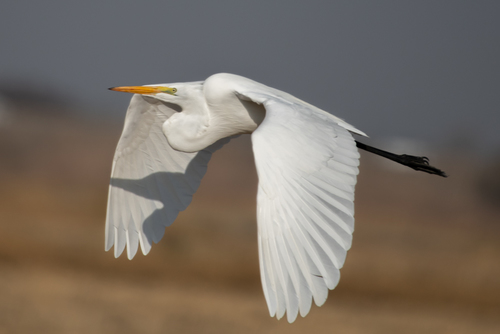
Great Egret
Ardea alba
A towering icon of the wetlands, the Great Egret combines statuesque patience with a lightning-fast strike. Once hunted to the brink of extinction for their elegant plumes, these resilient white giants are now a common and majestic sight in backyards across the globe.
Quick Identification
Size
Length: 80–104 cm (31–41 in); Wingspan: 131–170 cm (52–67 in); Weight: 700–1,500 g (1.5–3.3 lbs)
Colors
Dazzling pure white plumage; bright yellow bill; black legs and feet. During breeding, the face patch turns neon green.
Key Features
- Entirely white feathers
- Long, sharp yellow bill
- Black legs and feet
- Long 'S' shaped neck
- Large size, standing nearly 1 metre tall
When You’ll See Them
Sightings on EverydayEarth
Jun 29, 2026
A nighttime scene in a swamp rookery shows several wading birds roosting in the cypress branches. Multiple White Ibises are perched on the left, occasionally shifting their heads and showing their long, curved bills. In a group on the right, a Roseate Spoonbill is visible, identifiable by the unique shape of its bill as it grooms or adjusts its position. A Great Egret stands tall near the center of the roosting group.
Jun 29, 2026
Several American Alligators are basking on the sunny muddy banks of a waterway. One large individual rests in the foreground near a palm tree, while others are visible further back and swimming in the water. A Great Egret is seen foraging along the shoreline on the right, occasionally moving through the shallow water.
Jun 28, 2026
Multiple wading birds are active along the water's edge in a sunny swamp environment. A Tricolored Heron walks along the shaded muddy bank in the background, while a Great Egret and a Snowy Egret forage in the shallow water to the right. A white bird briefly flies through the lower-left foreground near the end of the clip.
Jun 28, 2026
A Tricolored Heron walks slowly along the muddy shore of a swampy area, pausing to look around. In the background, a Great Egret remains perched and motionless on a fallen branch above the water.
Jun 28, 2026
Several species of large wading birds are seen perched together on a sun-drenched branch. A Roseate Spoonbill stands at the highest point, preening its pink feathers with its specialized bill. Below it, a Great Egret and an Anhinga rest quietly, occasionally shifting their positions and looking around at the surrounding marsh environment.
Jun 28, 2026
A large pod of hippopotamuses is seen cooling off in and around a watering hole. Many are partially submerged in the center and left of the pond, while others rest on the muddy banks and rocks to the right. A white Great Egret flies across the scene from right to left above the water during the first few seconds of the video.
Geographic range
Where Does the Great Egret Live?
The Great Egret is a true global citizen, native to nearly every temperate and tropical region on Earth. In the Western Hemisphere, they are found from southern Canada through the United States and all the way to the tip of South America. They are also widely distributed across Africa, southern Europe, and throughout much of Asia and Australia, making them one of the most widely recognized wading birds in the world.
Basemap © OpenStreetMap contributors
Behavior
The Great Egret is a master of the 'stand and wait' hunting technique. You will often see them perfectly still in shallow water, poised like a statue, before they strike with lightning speed to spear a fish. They are generally solitary hunters, fiercely defending their immediate fishing territory from other egrets with croaking calls and aggressive posturing.
Despite their lone-wolf hunting style, they are highly social when it comes to nesting. They gather in large, noisy colonies called rookeries, often alongside other species like Great Blue Herons and Snowy Egrets. In flight, they are incredibly graceful, tucking their neck back against their shoulders and letting their long black legs trail behind them, beating their massive wings in a slow, rhythmic pulse.
EverydayEarth exclusive
Camera Tips
To capture the Great Egret on your backyard or trail camera, placement is everything. These birds prefer the very edge of the water—usually where the depth is less than 10 inches. Position your camera on a stake or low-hanging branch about 12-18 inches above the ground, angled slightly downward toward the shoreline. Avoid placing the camera where it will face the direct reflection of the sun off the water, as this can 'blow out' the white feathers of the egret, leaving you with a ghostly white blur.
Because Great Egrets are tall, ensure your field of view is wide enough to capture their full height. If you are using a trigger-based camera, set the sensitivity to high; egrets often move very slowly and might not trigger less sensitive sensors. A 'burst mode' or short video clips (15-20 seconds) are ideal for capturing the dramatic moment of a strike when they spear their prey.
You don't necessarily need traditional bait for these birds. Instead, focus on the 'lure' of a healthy ecosystem. If your pond has small fish, frogs, or dragonflies, the egrets will find it. During the breeding season (spring and early summer), they are more active and bolder, often venturing closer to homes if there is a quiet, undisturbed water source available. Early morning light is the 'golden hour' for egrets, as the low sun angle highlights the texture of their white feathers without overexposing them.
Similar Species
Species that look similar or are commonly confused with Great Egret.
Snowy Egret
Much smaller with a black bill and bright yellow feet (often called 'golden slippers').
Great Blue Heron (White Morph)
Found mostly in Florida, it is larger than the Great Egret with pale legs instead of black ones.
Little Egret
Common in Europe and Asia; much smaller than the Great Egret with a black bill and yellow feet.
Frequently Asked Questions
Record Great Egret at your habitat
Connect a camera to start building your own species record — AI identifies every visitor automatically.