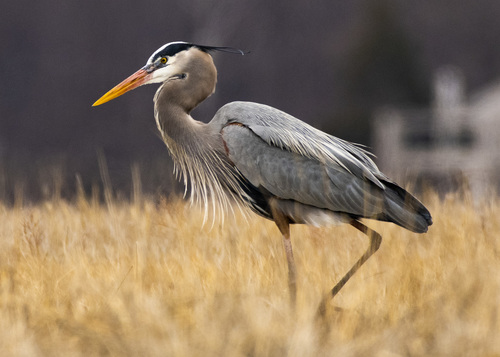
Great Blue Heron
Ardea herodias
With its prehistoric silhouette and statuesque patience, the Great Blue Heron is the crown jewel of North American wetlands. A master of the 'wait-and-strike' hunt, this elegant giant brings a touch of wild majesty to any backyard pond or local shoreline.
Quick Identification
Size
Length: 38–54 in (97–137 cm); Wingspan: 66–79 in (167–201 cm); Weight: 4.6–7.9 lbs (2.1–3.6 kg)
Colors
Blue-gray body with a white face and a broad black stripe extending from the eye to the back of the head. Thighs are brownish-red. Sexes look similar, though males are slightly larger.
Key Features
- Long, S-shaped neck and dagger-like yellow bill
- Shaggy feathers on the neck and back during breeding season
- Massive wingspan with slow, rhythmic wingbeats
- Black 'eyebrow' plume ending in long head feathers
When You’ll See Them
Sightings on EverydayEarth
Jun 26, 2026
A Great Blue Heron is seen standing on the muddy bank of a swamp. It looks around briefly before taking flight and moving off-camera. Meanwhile, an American Alligator remains perfectly still, partially submerged in the shallow water on the right side of the frame.
Jun 13, 2026
Several American Alligators are basking on the muddy bank near the water. One large individual rests in the foreground partially shaded by a tree, while a group of others are clustered together further back. To the right, a Great Blue Heron stands perfectly still on a partially submerged log, watching the water.
Jun 13, 2026
A group of American Alligators is gathered on the muddy bank, basking in the midday sun. Two large individuals are prominent in the foreground, showing their thick, armored tails and scaly skin. In the background, a Great Blue Heron stands perfectly still on a partially submerged log, keeping a close watch on the water for potential prey.
May 29, 2026
A Great Blue Heron is nestled within a large stick structure high in the pine branches. The bird shifts its weight and turns its head, revealing its long, sharp bill and the dark plumage of its crest against the bright morning sky.
May 25, 2026
Two Great Blue Herons are perched at a large stick nest high in a pine tree. One heron is diligently preening its feathers, while the other stands prominently above the nest, looking out over the landscape.
May 24, 2026
A Great Blue Heron is seen standing in its nest high in a pine tree. The bird stretches its long neck vertically and performs preening behaviors, using its beak to groom the feathers along its neck while looking around the surrounding canopy.
Geographic range
Where Does the Great Blue Heron Live?
Native to the North American continent, the Great Blue Heron maintains a massive range that stretches from the southern shores of Alaska and central Canada all the way down through the United States and Mexico into Central America. These majestic waders are found year-round along the Atlantic and Pacific coasts, while inland populations in the northern U.S. and Canada typically migrate south for the winter. They are also common residents of the Caribbean and the Galápagos Islands, making them one of the most widely distributed large waterbirds in the Western Hemisphere.
Basemap © OpenStreetMap contributors
Behavior
The Great Blue Heron is a master of patience, often seen standing motionless for hours along the edges of ponds, lakes, and marshes. These solitary hunters use a 'strike-and-wait' technique, where they remain perfectly still until a fish or frog swims within range, then lunge with lightning speed. While they are silent and stoic when hunting, they are surprisingly vocal when startled or at their nesting sites, emitting a harsh, prehistoric-sounding croak that can be heard from a great distance.
In the air, they are easily identified by their tucked-in necks and long legs trailing behind them. Unlike many other birds, they don't form tight flocks during the day, but they are highly social during the breeding season. They gather in 'rookeries' or colonies, building large stick nests high in trees near water. In suburban environments, they have become quite bold, frequently visiting backyard koi ponds or golf course water hazards, showing a remarkable ability to adapt to human presence as long as they aren't directly harassed.
EverydayEarth exclusive
Camera Tips
To capture high-quality footage of a Great Blue Heron, camera placement is everything. These birds have incredible eyesight and are easily spooked by sudden movements. Position your camera on a low tripod or a post near the water's edge, aimed at a clear opening where the heron has a 360-degree view. They prefer 'hunting stages'—submerged logs, flat rocks, or shallow sandbars—where they can wait for fish to pass. Setting your camera about 2 to 3 feet off the ground at a slight upward angle will emphasize their impressive height and prehistoric features.
Because herons move very slowly when stalking, standard PIR (motion) sensors can sometimes fail to trigger or may cut off the recording too early. If your camera allows it, increase the motion sensitivity to the highest setting and set the 'post-roll' or video length to at least 30 seconds. This ensures you catch the moment they transition from a frozen statue to a lightning-fast strike. If you are monitoring a backyard pond, place the camera so it overlooks the shallowest entry point, as this is where they are most likely to land.
Lighting is your best friend with this species. Their blue-gray plumage looks most striking during the 'golden hours' of dawn and dusk. If your camera has a time-lapse mode, consider using it during the early morning hours (6:00 AM to 9:00 AM). Herons are also active hunters at night, especially during a full moon, so ensure your camera's infrared flash is clean and unobstructed to capture their nocturnal fishing expeditions. Avoid using white LED flashes if possible, as the sudden burst of light will likely drive the bird away from your yard for several days.
Similar Species
Species that look similar or are commonly confused with Great Blue Heron.
Frequently Asked Questions
Record Great Blue Heron at your habitat
Connect a camera to start building your own species record — AI identifies every visitor automatically.