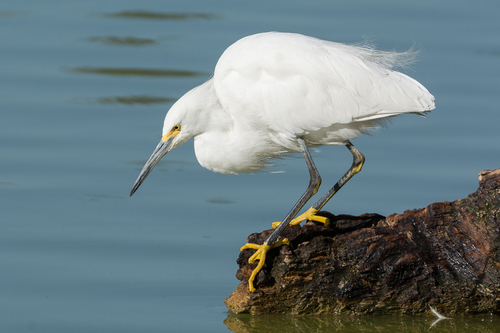
Snowy Egret
Egretta thula
Known for their 'golden slippers' and elegant white plumes, the Snowy Egret is the most energetic dancer of the marsh. Watch for their spirited hunting displays as they stir up the shallows with a splash of color.
Quick Identification
Size
Length: 22-26 in (56-66 cm); Wingspan: 39 in (100 cm); Weight: 13 oz (370 g)
Colors
Pure white plumage; black bill; bright yellow lores (skin between eyes and bill); black legs with iconic bright yellow feet.
Key Features
- Bright yellow 'golden slippers' on the feet
- Thin, jet-black bill
- Long, shaggy plumes on the head, neck, and back during breeding season
- Elegant, slender S-curved neck
When You’ll See Them
Sightings on EverydayEarth
Jun 29, 2026
In a dense nesting thicket overhanging the water, two white birds are visible. A juvenile bird in the foreground is focused on preening its downy white feathers, while another bird perches on the branches above, scanning the surrounding swamp.
Jun 28, 2026
Multiple wading birds are active along the water's edge in a sunny swamp environment. A Tricolored Heron walks along the shaded muddy bank in the background, while a Great Egret and a Snowy Egret forage in the shallow water to the right. A white bird briefly flies through the lower-left foreground near the end of the clip.
Jun 28, 2026
A Snowy Egret forages along the shoreline in the foreground, its bright yellow feet visible as it steps through the mud. In the center, an Anhinga walks from the bank into the water, while an American Alligator floats nearly motionless near some fallen logs in the middle of the swamp.
Jun 28, 2026
Several juvenile Snowy Egrets are visible in a stick nest nestled within lush green foliage overhanging the water. One chick is particularly active, preening its wings and stretching its neck, while the others rest. An adult bird is partially visible perched on a branch directly above the nest.
Jun 28, 2026
Two juvenile Snowy Egrets are perched on palm fronds within a rookery. The bird on the left is active, stretching its neck and preening its fluffy white feathers, while the bird on the right remains tucked and stationary. A third bird is partially visible in the background vegetation.
Jun 27, 2026
A Snowy Egret flies into the scene from the right, briefly landing on the branches of a green bush before taking flight again to the left.
Behavior
The Snowy Egret is the most animated of the North American herons. Unlike the patient, statuesque Great Egret, the Snowy is a high-energy hunter. You will often see them sprinting through shallow water, vibrating their wings, or using their bright yellow feet to stir up the muddy bottom to flush out prey. This 'dancing' behavior makes them a joy to watch and a dynamic subject for backyard observers near water.
Socially, they are quite gregarious, often nesting in large colonies called rookeries alongside other wading birds like Ibises and Great Blue Herons. While they are generally peaceful, they can be quite territorial about their specific fishing spot, often letting out a raspy croak to warn off intruders. Their history is one of resilience; they were nearly hunted to extinction in the late 19th century for their beautiful 'aigrette' plumes, which were popular in the fashion industry.
EverydayEarth exclusive
Camera Tips
Capturing the Snowy Egret on camera requires careful attention to light. Because their feathers are a brilliant, reflective white, they often 'blow out' in direct midday sun, leaving you with a featureless white blob. Set your camera’s exposure compensation to -1.0 or -2.0 to preserve the delicate texture of their plumes. The best shots occur during the 'golden hours' of dawn and dusk when the soft light hits their feathers from the side, highlighting their elegant silhouettes.
For placement, position your AI-powered camera on a low-profile stake or tripod just 1-2 feet above the water level. Snowy Egrets spend most of their time looking down, so a low-angle shot captures their facial expressions and the splash of their 'foot-stirring' hunting style much better than a camera mounted high on a tree. Look for 'choke points' in local wetlands or shallow edges of your pond where small fish tend to congregate; this is where the egret will spend the most time standing still.
Since Snowy Egrets are highly mobile and prone to sudden bursts of speed when chasing fish, use a high shutter speed or a 'sports' mode if your camera allows. If you are using a triggered trail camera, set it to take a burst of 3-5 photos rather than a single shot. This increases your chances of catching that perfect moment when they have their wings flared or a fish in their bill. Avoid using bright white flashes at night; while they are diurnal, they may roost nearby and a harsh flash can spook them from the area.
Similar Species
Species that look similar or are commonly confused with Snowy Egret.
Frequently Asked Questions
Record Snowy Egret at your habitat
Connect a camera to start building your own species record — AI identifies every visitor automatically.