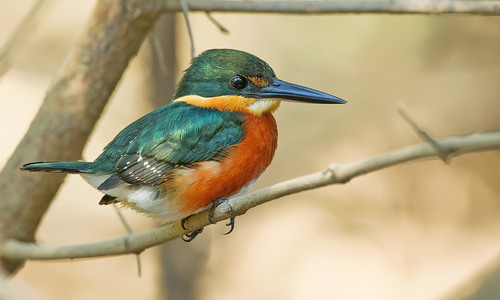
American Pygmy Kingfisher
Chloroceryle aenea
The American Pygmy Kingfisher is a shimmering emerald jewel of the Neotropical wetlands. As the smallest kingfisher in the Americas, this elusive hunter proves that the most stunning wildlife often comes in the smallest packages.
Quick Identification
Size
Length: 12.5–13.5 cm (4.9–5.3 in); Wingspan: 20–22 cm (7.8–8.6 in); Weight: 14–18 g (0.5–0.6 oz)
Colors
Upperparts are deep metallic bronze-green; males have rufous underparts with a white lower belly; females have a dark green breast band.
Key Features
- Tiny sparrow-sized frame with a large heavy bill
- Metallic bronze-green upperparts
- Rufous (orange-brown) throat and breast
- Short tail and white lower abdomen
When You’ll See Them
Geographic range
Where Does the American Pygmy Kingfisher Live?
Native to the Neotropical regions of the Americas, the American Pygmy Kingfisher occupies a vast territory stretching from southern Mexico through Central America and across most of South America. Its core range includes the humid lowlands of the Amazon Basin, the Guyanas, and coastal Brazil, extending as far south as northern Argentina and Paraguay. It is also a resident inhabitant of the island of Trinidad, though it is notably absent from the high-altitude Andes mountains and the arid southern reaches of the continent. There are no known introduced populations outside of its native range.
Basemap © OpenStreetMap contributors
Behavior
The American Pygmy Kingfisher is a shy and largely silent hunter of the tropical understory. Unlike its larger, more boisterous relatives, this species rarely hovers or perches in the open. Instead, it spends long periods sitting perfectly still on low, shaded branches or exposed roots just inches above the water's surface. It is a solitary bird, often overlooked due to its diminutive size and preference for the dense shadows of overhanging vegetation.
When foraging, it uses a sit-and-wait strategy, scanning the water for small fish or aquatic larvae. Once a target is spotted, it executes a lightning-fast plunge-dive, often returning to the same branch to consume its meal. It is a highly territorial resident, rarely venturing far from its chosen stretch of water. Though it is not known for a loud song, it occasionally gives a soft, high-pitched 'tst' call during flight or when slightly agitated.
EverydayEarth exclusive
Camera Tips
Capturing the American Pygmy Kingfisher on a trail camera requires precision because of their tiny size and preference for dark, shaded environments. The best placement is along narrow, slow-moving creeks or the edges of mangrove swamps where the water is calm. Look for horizontal branches or thick roots that hang low over the water—ideally between 1 and 3 feet above the surface. These birds are creatures of habit and will often return to the exact same 'fishing perch' every day. If you see tiny white droppings on a low branch over water, you’ve found the perfect spot.
Because these birds are active in the dense shade of the forest understory, your camera needs to handle low-light conditions well. If your camera has adjustable trigger sensitivity, set it to the highest level; a bird this small might not trigger a standard PIR sensor at a distance. Use a fast shutter speed or high-speed burst mode to freeze the action of their rapid dives. Positioning the camera 4 to 6 feet away from the target perch at a 45-degree angle will provide the best profile shots without being so close that the flash overexposes the bird’s metallic feathers.
For the best results, avoid placing cameras in areas with heavy wind-blown foliage, as the constant movement will result in thousands of false triggers. Instead, clear a small 'window' in the vegetation to give your camera a clear line of sight to a specific perching branch. While they are active throughout the day, the first few hours after dawn offer the highest level of activity. If you are using a solar-powered AI camera, ensure the panel is positioned higher up in the canopy where it can actually catch the sun, as the kingfisher's preferred haunts are often too dark for effective charging.
Similar Species
Species that look similar or are commonly confused with American Pygmy Kingfisher.
Frequently Asked Questions
Record American Pygmy Kingfisher at your habitat
Connect a camera to start building your own species record — AI identifies every visitor automatically.