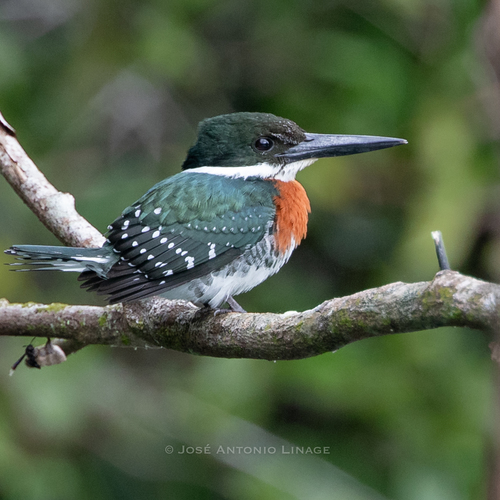
Green Kingfisher
Chloroceryle americana
A pint-sized predator of the water's edge, the Green Kingfisher is a master of the low-altitude ambush. With its metallic emerald feathers and lightning-fast dives, it brings a touch of tropical brilliance to any backyard stream.
Quick Identification
Size
Length: 19–21 cm (7.5–8.3 in); Wingspan: 25–30 cm (10–12 in); Weight: 27–40 g (0.9–1.4 oz)
Colors
Glossy dark green upperparts with white spotting; white underparts. Males have a broad chestnut (rufous) breast band; females have two thin green breast bands.
Key Features
- Glossy dark green crown and back
- Wide white collar around the neck
- Dagger-like black bill
- Short tail and stocky profile
- Male has a distinctive rufous chest band
When You’ll See Them
Geographic range
Where Does the Green Kingfisher Live?
The Green Kingfisher is a wide-ranging resident of the Americas, natively found from the southern tip of Texas in the United States throughout Mexico and Central America. Its core range extends deep into South America, covering every mainland country except Chile, flourishing in tropical and subtropical lowlands. While they are primarily residents of Latin America, they are a sought-after specialty for birders in the Rio Grande Valley and along the southwestern border of the U.S.
Basemap © OpenStreetMap contributors
Behavior
The Green Kingfisher is a stealthy, solitary hunter that prefers to stay low to the water, often hiding in the shadows of overhanging vegetation. Unlike its larger relatives that perching high on power lines, this species usually sits on low branches or roots just inches above the surface, making it much harder to spot despite its vibrant colors.
When hunting, it remains motionless for long periods before performing a sudden, vertical plunge into the water to snatch small fish. After a successful catch, it returns to its perch to beat the prey against a branch before swallowing it head-first. They are territorial birds and will defend their stretch of shoreline with sharp, clicking 'tik-tik-tik' calls.
While they are generally shy around humans, they can become accustomed to quiet observers. They are mostly non-migratory, maintaining the same territory year-round as long as the water doesn't freeze or dry up, making them excellent subjects for long-term backyard monitoring in the right climate.
EverydayEarth exclusive
Camera Tips
To capture a Green Kingfisher on camera, you must focus on 'perch hunting.' These birds are creatures of habit and will return to the same low-hanging branches over water day after day. Look for a branch about 1 to 3 feet above a slow-moving pool or stream. Position your camera on a stake or a nearby tree trunk, aiming it slightly downward toward the water where the bird is likely to dive, or level with the favorite perch.
Because these birds are small and fast, you need a camera with a quick trigger speed (0.2s or faster) and a high frame rate. If your camera supports 'Burst Mode,' set it to take 3-5 photos per trigger. This increases your chances of catching the splash of a dive or the bird mid-flight. Since they frequent shady areas under canopy cover, ensure your camera has a high-quality sensor that performs well in low-light conditions without becoming too grainy.
Video mode is particularly rewarding for this species. Set your video length to at least 15-20 seconds to capture the sequence of the bird spotting a fish, diving, and returning to the branch to process its meal. If you are setting up in a backyard with a pond, adding a small 'natural' perch—a weathered branch stuck into the mud near the water's edge—can act as a magnet for them. Position the camera about 6-10 feet away from this perch to ensure the bird fills the frame without being so close that the focus softens.
Similar Species
Species that look similar or are commonly confused with Green Kingfisher.
Frequently Asked Questions
Record Green Kingfisher at your habitat
Connect a camera to start building your own species record — AI identifies every visitor automatically.