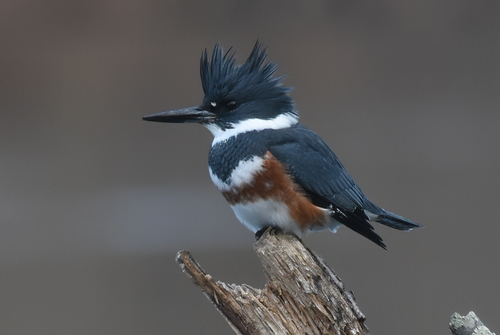
Belted Kingfisher
Megaceryle alcyon
With its shaggy crest and piercing rattle, the Belted Kingfisher is the master of the waterfront. This expert diver is one of the few bird species where the female is more vibrantly colored than the male.
Quick Identification
Size
Length 28–35 cm (11–14 in); wingspan 48–58 cm (19–23 in); weight 140–170 g (4.9–6.0 oz)
Colors
Slate blue-gray upperparts and white underparts. Males feature a single blue breast band; females uniquely sport two bands—one blue and one rufous (rusty-brown) across the belly.
Key Features
- Prominent shaggy double crest on a large head
- Long, heavy, dagger-like black bill
- White 'neck-ring' between head and breast band
- Stocky body with short legs and small feet
When You’ll See Them
Sightings on EverydayEarth
Apr 25, 2026
An Anhinga is perched prominently on a weathered, leafless branch, stretching its long neck and looking toward the sky. Below and to the right, a Belted Kingfisher rests quietly among the green needles of a branch, its shaggy crest clearly visible. A white bird briefly flies through the background in the upper right.
Geographic range
Where Does the Belted Kingfisher Live?
Native to the North American continent, the Belted Kingfisher maintains a massive range stretching from the subarctic regions of Alaska and Canada down through the entire United States. While populations in the northernmost reaches are migratory, moving south as waterways freeze over, those in the lower 48 states are often year-round residents near open water. During the winter months, many birds push further south into Mexico, Central America, and the Caribbean, with some individuals reaching the northern coasts of South America. This species is highly adaptable and can be found anywhere there is a reliable source of fish and a place to perch.
Basemap © OpenStreetMap contributors
Behavior
Solitary and highly territorial birds, Belted Kingfishers are easily recognized by their loud, dry rattling call that echoes across the water. They spend much of their time perched on exposed branches, wires, or piers overlooking clear water, where they patiently scan for movement below. They are fiercely defensive of their fishing territories and will often chase off intruders with aggressive aerial displays and vocalizations.
When a fish is spotted, the kingfisher may hover briefly in mid-air before performing a spectacular headfirst plunge-dive into the water. Unlike many other birds that nest in trees, Belted Kingfishers are excavators; they use their bills and feet to dig horizontal tunnels up to eight feet long into vertical earthen banks. These burrows usually slope upward to prevent flooding and protect the nesting chamber at the end.
EverydayEarth exclusive
Camera Tips
The secret to capturing a Belted Kingfisher on camera is identifying their favorite perches. These birds are creatures of habit and will return to the same dead branch or fence post overlooking a pond multiple times a day. Mount your camera 5 to 10 feet away from a known 'fishing perch,' angling the lens slightly downward. If you don't have a natural perch in view, you can 'landscape' your yard by sticking a sturdy, attractive branch into the mud near the water's edge to lure them into the frame.
Because kingfishers are incredibly fast when diving and taking off, trigger speed is everything. Use a camera with a trigger speed of 0.2 seconds or faster. Set your device to 'Burst Mode' or a high-frame-rate video setting. This ensures you catch the moment they emerge from the water, which is often a spectacular spray of droplets and a silver fish clamped in their bill. Early morning light is best for highlighting the subtle slate-blue texture of their feathers.
If you live near a creek with vertical dirt banks, look for 3-4 inch circular holes. These are likely nest burrows. Positioning a camera at a distance to monitor the entrance during late spring can provide fascinating footage of the 'fish delivery' service parents provide to their young. However, never place the camera so close that it obstructs the flight path or disturbs the nesting pair, as they are sensitive to changes near the burrow entrance.
Similar Species
Species that look similar or are commonly confused with Belted Kingfisher.
Frequently Asked Questions
Record Belted Kingfisher at your habitat
Connect a camera to start building your own species record — AI identifies every visitor automatically.