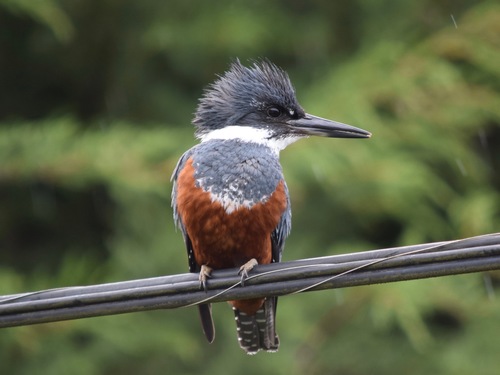
Ringed Kingfisher
Megaceryle torquata
The largest kingfisher in the Americas, the Ringed Kingfisher is a master of the plunge-dive and a common sight along tropical and subtropical waterways. With its shaggy crest and loud, rattling call, it is one of the most charismatic birds you can discover near the water.
Quick Identification
Size
Length: 36-41 cm (14-16 in); Wingspan: 64-74 cm (25-29 in); Weight: 300-440 g (10.6-15.5 oz)
Colors
Blue-grey upperparts and crest, white collar, and deep rufous underparts. Males have an entirely rufous belly, while females feature a blue-grey band across the upper chest.
Key Features
- Massive, shaggy blue-grey crest
- Extremely large, heavy black bill with a pale base
- Deep rufous/rusty belly and underwing coverts
- White collar around the neck
When You’ll See Them
Geographic range
Where Does the Ringed Kingfisher Live?
Native to the Americas, the Ringed Kingfisher occupies a vast territory stretching from the southern tip of Texas in the United States down through Mexico and Central America to the very tip of South America in Tierra del Fuego. It is the most widespread and common large kingfisher in the Neotropics, thriving in almost every country across the South American continent. While it is primarily a lowland species, it can be found in suitable aquatic habitats from tropical coasts to temperate southern forests.
Basemap © OpenStreetMap contributors
Behavior
The Ringed Kingfisher is a bold and conspicuous bird, often seen perched motionless on high, exposed branches, power lines, or bridges overlooking deep water. It is a highly territorial species, and its presence is frequently announced by a loud, dry rattling call or a rhythmic 'clack-clack' that can be heard from quite a distance. Despite its large size, it is incredibly agile in flight, moving with deep, measured wingbeats between its favorite hunting spots.
When hunting, this bird is a master of patience. It will sit for long periods scanning the water before launching into a dramatic, steep plunge-dive to snatch fish. They are generally solitary outside of the breeding season and are quite wary of human approach, though they have adapted well to living near human infrastructure like docks, dams, and irrigation canals. Their social interactions are usually limited to noisy territorial disputes or pair-bonding during the nesting season, which involves excavating long tunnels in riverbanks.
EverydayEarth exclusive
Camera Tips
To capture the Ringed Kingfisher on camera, location is everything. These birds are creatures of habit and will use the same 'sentinel' perches day after day. Look for prominent, dead branches that hang over deep water or lookouts on docks and piers. Position your camera on a tripod or mount it to a nearby structure at a height of 6 to 10 feet. Because they are wary of movement, camouflage for your camera housing or placing it well in advance is essential to ensure they feel comfortable returning to the spot.
Since these birds are most active when the sun is out to illuminate their prey, set your camera's trigger schedule for daylight hours. High-speed shutter settings are a must if you hope to capture their dramatic diving action; a trigger speed of 0.2 seconds or faster is recommended. If your camera supports 'Pro-Capture' or high-frame-rate video, use it to catch the moment they break the water's surface, as the splash and subsequent flight are spectacular.
While you can't easily bait a kingfisher with traditional birdseed, you can 'engineer' a perfect photo op. If you have a backyard pond or waterfront property, installing a T-shaped perch made of natural driftwood in a clear area will almost certainly attract any local kingfishers looking for a better vantage point. Ensure the sun is behind the camera during the peak morning or afternoon hours to highlight the vibrant rufous and blue-grey plumage against the water.
Similar Species
Species that look similar or are commonly confused with Ringed Kingfisher.
Belted Kingfisher
Much smaller with a white belly; the Ringed Kingfisher has a massive bill and extensive rufous coloring across the entire underbelly.
Amazon Kingfisher
Lacks the shaggy crest of the Ringed Kingfisher and is smaller; the male Amazon has a white belly with a rufous chest band, rather than a full rufous belly.
Frequently Asked Questions
Record Ringed Kingfisher at your habitat
Connect a camera to start building your own species record — AI identifies every visitor automatically.