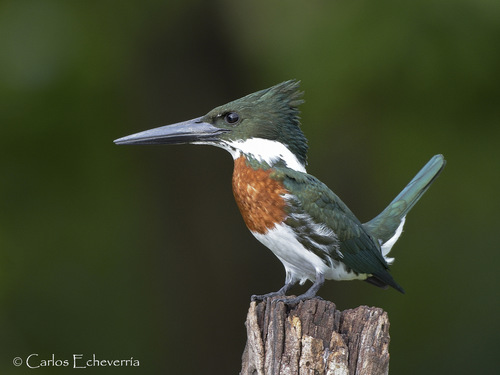
Amazon Kingfisher
Chloroceryle amazona
A striking master of the tropical waterways, the Amazon Kingfisher is easily identified by its shaggy green crest and its habit of plunging headfirst into the water for a meal. This bold hunter is a favorite for backyard observers near rivers and lakes.
Quick Identification
Size
Length of 29–30 cm (11.5–12 in); wingspan approx. 40–45 cm (16–18 in); weight 110–140g (3.9–4.9 oz).
Colors
Upperparts are oily dark green with a shaggy crest and white collar. Males have a broad chestnut breast band; females have green patches on the sides of a white breast.
Key Features
- Oily dark-green upperparts and shaggy crest
- Broad chestnut breast band in males
- Solid green wings without white spotting
- Heavy, dagger-like black bill
- Distinctive white collar and underparts
When You’ll See Them
Geographic range
Where Does the Amazon Kingfisher Live?
The Amazon Kingfisher is a quintessential resident of the American tropics, with a vast native range starting in southern Mexico and extending through Central America. It is found throughout the South American lowlands, covering the Amazon basin and reaching as far south as northern Argentina and Uruguay. This species is a lowland specialist, thriving in humid environments where water bodies are flanked by dense vegetation or forest edges.
Basemap © OpenStreetMap contributors
Behavior
The Amazon Kingfisher is a patient and methodical hunter, typically found perched on low-hanging branches or snags overhanging slow-moving water. From these vantage points, it scans the water with intense focus before executing a sudden, vertical plunge-dive to snatch small fish. Unlike some of its more skittish relatives, this species is relatively bold and will often remain on its perch if observers remain quiet and at a respectful distance.
These birds are primarily solitary or seen in pairs, fiercely defending their territorial stretches of shoreline. They are highly vocal, often giving away their presence with a loud, metallic rattling call when flying between perches or when disturbed. While they are not specifically social with humans, they are increasingly adapted to human-altered landscapes, provided there are clean water sources and sufficient fish populations.
EverydayEarth exclusive
Camera Tips
To successfully capture the Amazon Kingfisher on a trail camera, focus on their 'fishing perches.' These birds are creatures of habit and will return to the same horizontal branch or dead snag daily. Mount your camera approximately 10 to 15 feet away from a branch that hangs 2 to 5 feet above the water. A side-on angle is best to capture the full profile of their crest and the male's chestnut breast band.
Since these birds are extremely fast during their dive, use a camera with a high trigger speed. If your AI-powered camera has a 'Bird' detection mode, ensure it is set to high sensitivity. Because they spend long periods sitting perfectly still while scanning for fish, motion-only triggers might miss the subtle head movements; time-lapse modes set to short intervals can be a great backup to catch them during their long waits.
Lighting is critical for showing off their oily-green plumage. Position your camera so it faces away from the sun (North or South) to avoid lens flare from the water's surface. Early morning and late afternoon are the golden hours for activity. If you are trying to attract them to a suburban pond, ensure there is a clear perching spot with a clean line of sight into the water, as they will ignore ponds where the surface is completely covered by lilies or debris.
Similar Species
Species that look similar or are commonly confused with Amazon Kingfisher.
Frequently Asked Questions
Record Amazon Kingfisher at your habitat
Connect a camera to start building your own species record — AI identifies every visitor automatically.