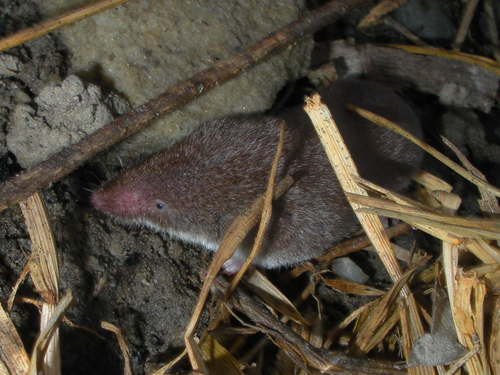
American Pygmy Shrew
Sorex hoyi
Meet one of the smallest mammals on Earth, a tiny powerhouse that must eat every few hours to survive. The American Pygmy Shrew is a master of the undergrowth, living a high-speed life beneath the forest floor.
Quick Identification
Size
Total length 3.2–3.8 in (81–96 mm); Weight 0.07–0.14 oz (2–4 g)
Colors
Uniform grayish-brown to reddish-brown upperparts with a lighter, silvery-grey underbelly; tail is bicolored with a dark top and pale underside.
Key Features
- Extremely small size, often weighing less than a penny
- Distinctly short tail, roughly one-third of total body length
- Elongated, pointed snout with prominent whiskers
- Minute black eyes and ears nearly hidden by fur
When You’ll See Them
Geographic range
Where Does the American Pygmy Shrew Live?
The American Pygmy Shrew is native to the northern reaches of North America, boasting a massive range that stretches from the subarctic forests of Alaska and across the entirety of Canada. In the United States, it is found throughout the Great Lakes region and New England, with southern extensions following the high-elevation corridors of the Appalachian Mountains and isolated pockets in the Rocky Mountains of Colorado and Wyoming. This species is a specialist of the northern wilderness, thriving in cool, damp environments where the forest floor provides a rich buffet of invertebrates.
Basemap © OpenStreetMap contributors
Behavior
The American Pygmy Shrew is a tiny engine of constant motion. Possessing one of the highest metabolic rates of any mammal, it lives life in a state of perpetual urgency. Because its body burns energy so rapidly, it must consume its own weight in food every few hours just to survive. This results in a polyphasic activity cycle, where the shrew alternates between frantic foraging and short naps throughout both day and night, regardless of the season.
These shrews are solitary and highly territorial, though their territories are understandably small. They are expert navigators of the 'leaf litter' zone, using their sensitive whiskers and keen sense of smell to locate prey in the dark, damp crevices of the forest floor. While they do not hibernate and remain active even under deep snow, they are rarely seen by humans due to their size and preference for staying under cover.
EverydayEarth exclusive
Camera Tips
Capturing an American Pygmy Shrew on camera is the ultimate challenge for backyard naturalists because of their microscopic size and lightning-fast movements. Standard PIR (Passive Infrared) sensors on many trail cameras are often not sensitive enough to be triggered by an animal that weighs only two grams. To compensate, you should position your camera as close to the ground as possible, focusing on a specific 'bottleneck' like a gap under a rotting log or a known tunnel through thick leaf litter.
Because these shrews have a fixed focal range on standard cameras, the shrew may appear blurry if it gets too close. Using a camera with a dedicated macro lens or a close-focus modification is the best way to get a clear shot. Set your camera to 'Burst Mode' or 'High-Speed Video' to ensure you catch a frame where the shrew isn't just a brown blur, as they rarely stay still for more than a second.
Baiting is almost a necessity for this species. A small amount of high-protein wet cat food or mealworms placed inside a shallow dish or directly on a flat stone will act as a 'shrew station.' The scent will draw them in, and the opportunity for a high-calorie meal will pause their frantic foraging long enough for the camera to trigger. In winter, look for 'vent holes' in the snow near tree trunks, which are often used by shrews to access the surface.
Similar Species
Species that look similar or are commonly confused with American Pygmy Shrew.
Frequently Asked Questions
Record American Pygmy Shrew at your habitat
Connect a camera to start building your own species record — AI identifies every visitor automatically.