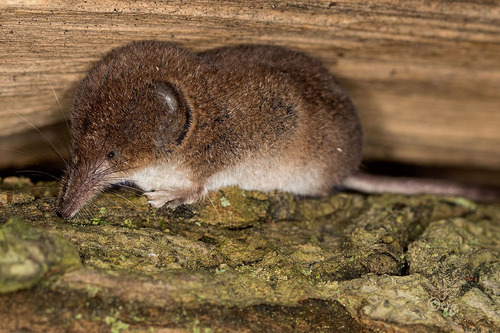
Masked Shrew
Sorex cinereus
Meet the Masked Shrew, a tiny powerhouse of the northern wilderness. Despite weighing less than a nickel, this energetic hunter is a master of the garden undergrowth, active every hour of every season.
Quick Identification
Size
Total length of 7.5–11 cm (3–4.3 in); weighs between 2.5–5.5 g (0.09–0.19 oz)
Colors
Dull brown to greyish-brown on the back with a lighter, silvery-grey underside and a bicolored tail
Key Features
- Extremely long, slender tail tipped with black
- Pointed, whiskered snout with tiny, bead-like eyes
- Velvety fur that can be brushed in any direction without resistance
When You’ll See Them
Geographic range
Where Does the Masked Shrew Live?
The Masked Shrew is the most widely distributed shrew in North America, claiming a massive territory that spans from the subarctic reaches of Alaska and northern Canada all the way to the Atlantic coast. In the United States, its presence is felt throughout the northern tier of states, reaching as far south as the central Appalachians and the Rocky Mountains. This hardy mammal thrives in diverse climates, from the humid forests of the Pacific Northwest to the frigid edges of the northern tundra.
Basemap © OpenStreetMap contributors
Behavior
The Masked Shrew is a creature of perpetual motion, possessing a metabolic rate so high that it must eat nearly its own body weight in food every 24 hours to survive. Because of this physiological demand, they do not hibernate and remain active through the harshest winters, often hunting in the 'sub-nivean' zone—the air-filled space between the ground and the bottom of the snowpack.
These shrews are primarily solitary and fiercely territorial, using high-pitched squeaks and scent marking to warn off intruders. While they are capable of digging their own small burrows, they are opportunistic and frequently use the abandoned tunnels of mice or voles. In the backyard, they are masters of the 'under-world,' navigating through thick mulch, leaf litter, and woodpiles where they remain largely invisible to predators and humans alike.
EverydayEarth exclusive
Camera Tips
Capturing a Masked Shrew on camera requires a specialized approach because of their minuscule size and lightning-fast movements. Standard trail cameras often struggle to trigger on such small heat signatures, so for the best results, use a camera with a high-sensitivity PIR sensor or a 'macro' lens capability. Position your camera just 2 to 5 inches off the ground, aiming it parallel to a log, stone wall, or the edge of a garden bed—natural 'guide rails' that shrews use for navigation.
Baiting is almost essential for getting a clear shot of these high-speed foragers. A small amount of wet cat food, peanut butter mixed with birdseed, or live mealworms placed in a shallow dish will encourage them to pause. Since they are active 24/7, ensure your camera's night vision (IR) is optimized; however, because they move so quickly, use the fastest shutter speed or highest frame-rate video mode available to prevent a blurry grey smudge on the recording.
Winter is actually a fantastic time for shrew photography. Look for 'vent holes'—tiny, pencil-sized chimneys in the snow near the base of trees. Placing a camera near these exits can capture them as they emerge for air or a quick surface dash. For the most creative footage, try a 'tunnel cam' setup: place your camera at one end of a short section of PVC pipe or a hollow log hidden in the garden, as shrews instinctively love exploring tight, dark spaces where they feel safe from hawks and owls.
Similar Species
Species that look similar or are commonly confused with Masked Shrew.
Frequently Asked Questions
Record Masked Shrew at your habitat
Connect a camera to start building your own species record — AI identifies every visitor automatically.