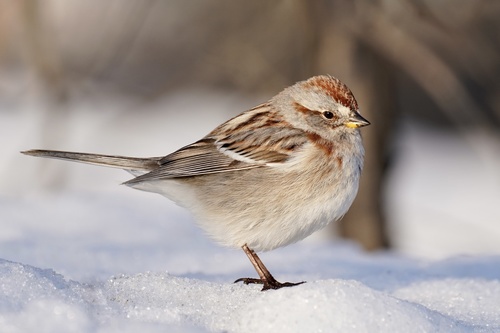
American Tree Sparrow
Spizelloides arborea
The American Tree Sparrow is a hardy winter wanderer, easily recognized by its rusty cap and a single dark 'stick-pin' spot on its breast. A common visitor to backyard feeders, this bird brings a touch of warmth and a musical 'tinkling' song to the coldest months of the year.
Quick Identification
Size
Length: 13–15 cm (5.1–5.9 in); Wingspan: 24 cm (9.4 in); Weight: 13–28 g (0.5–1.0 oz)
Colors
Rusty-red cap and eye line, grey face and underparts, brown streaked back, and two white wing bars. Adults feature a distinctive dark 'stick-pin' spot in the center of the breast.
Key Features
- Dark 'stick-pin' spot in the center of a plain grey breast
- Bicolored bill with a dark upper mandible and yellow lower mandible
- Rusty-red cap and a reddish-brown line extending behind the eye
- Two white wing bars on reddish-brown wings
When You’ll See Them
Sightings on EverydayEarth
Mar 3, 2026
Various bird species visit the feeder tray in quick succession to forage. Initially, a male House Finch and an American Tree Sparrow are present. They are later replaced by a pair of House Sparrows (male and female). The sequence ends with an American Robin landing abruptly on the rim of the tray, filling the camera's view.
May 10, 2026
An American Tree Sparrow lands on the edge of the feeder tray, hopping among the seeds. Its reddish cap and the characteristic dark 'stickpin' spot in the center of its breast are clearly visible as it forages before moving deeper into the tray.
May 6, 2026
An American Tree Sparrow is seen on the seed-filled tray. It looks down at the food for a brief moment before quickly hopping off-camera.
May 4, 2026
A male House Finch lands briefly on the edge of the feeder tray to inspect the seeds. On the ground below, another House Finch and several American Tree Sparrows are seen hopping through the grass and foraging for spilled seeds.
Apr 20, 2026
An American Tree Sparrow lands on the edge of the feeder tray and sifts through the sunflower seeds, looking around several times before taking flight. Another small bird can be seen foraging on the ground in the background.
Apr 19, 2026
An American Tree Sparrow feeds energetically on sunflower seeds at the front of the tray, showing off its rusty cap and bicolored bill. Meanwhile, another small bird perches briefly on the edge of a copper bowl in the background before flying away.
Geographic range
Where Does the American Tree Sparrow Live?
Native to the North American continent, the American Tree Sparrow boasts a vast range that shifts dramatically with the seasons. During the summer, they are found across the subarctic tundra of Alaska and Northern Canada, nesting on the ground amidst stunted trees. As winter approaches, the entire population migrates southward to cover a core range that includes Southern Canada and the majority of the contiguous United States, typically reaching as far south as the Texas panhandle and the Carolinas.
Basemap © OpenStreetMap contributors
Recorded on EverydayEarth
Behavior
American Tree Sparrows are charismatic winter visitors that are much more terrestrial than their name suggests. Despite being called 'tree' sparrows, they spend the vast majority of their time foraging on the ground or in low-lying shrubs. They are highly social during the winter months, often forming 'weed-patch' flocks with other sparrows and Dark-eyed Juncos. You will often see them hopping through the snow, scratching the surface to uncover fallen seeds.
These birds are known for their gentle 'tinkling' calls, which sound like little bells ringing across a frozen landscape. They have a relatively high tolerance for human presence, especially in backyards where food is provided. Interestingly, they maintain a strict hierarchy within their winter flocks, with older individuals usually dominating the best feeding spots. When approached, they tend to fly up into a nearby bush rather than taking a long-distance flight.
EverydayEarth exclusive
Camera Tips
To capture the best footage of American Tree Sparrows, focus your camera efforts at ground level. These birds are classic ground-feeders, so placing your AI-powered camera on a short tripod or mounting it just 6-12 inches off the ground near a brush pile or thicket will yield the most intimate shots. They feel safest when they have a quick escape route, so position the camera within 5 feet of a dense shrub or evergreen where they can dive for cover if a hawk appears.
Since these birds are primarily seen in the winter, managing your camera for cold weather is essential. Use lithium batteries to ensure longevity in freezing temperatures. To attract them specifically, scatter white proso millet or cracked corn directly on the ground or on a low platform feeder. They are less likely to use hanging tube feeders compared to other species, so a ground-level 'stage' created with a flat rock or a tray is your best bet for high-quality identification photos.
Pay attention to the light during the short winter days. Aim your camera toward the south to maximize the available sunlight on the bird's chest, which will help the AI identify the signature dark breast spot. If you have a heated bird bath, placing your camera nearby is a fantastic secondary strategy, as these sparrows need to drink and bathe even in sub-zero temperatures, often creating highly active and social 'splashing' videos.
Similar Species
Species that look similar or are commonly confused with American Tree Sparrow.
Chipping Sparrow
Lacks the dark breast spot and has a solid black bill; usually only found in northern areas during summer.
Field Sparrow
Has a distinct white eye-ring and a bright pink bill, lacking the rusty eye-line of the Tree Sparrow.
Dark-eyed Junco
Often flocks with Tree Sparrows but has a solid grey or hooded appearance with white outer tail feathers.
Frequently Asked Questions
Record American Tree Sparrow at your habitat
Connect a camera to start building your own species record — AI identifies every visitor automatically.