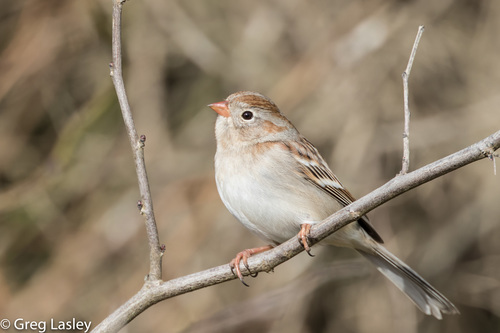
Field Sparrow
Spizella pusilla
With its signature pink bill and warm, rusty cap, the Field Sparrow is a gentle soul of the overgrown meadow. Watch for this small, shy songbird as it flits between tall grasses, filling the air with its iconic 'bouncing ball' melody.
Quick Identification
Size
Length: 12-15 cm (4.7-5.9 in); Wingspan: 20 cm (7.9 in); Weight: 11.5-15 g (0.4-0.5 oz)
Colors
Grey head with a rusty-red crown and eye line; unstreaked buff breast; white belly; bright pink bill
Key Features
- Bright pink bill
- Distinct white eye-ring
- Clear, unstreaked buff breast and sides
- Rusty crown and streak behind the eye
When You’ll See Them
Geographic range
Where Does the Field Sparrow Live?
Native to the eastern half of North America, the Field Sparrow is a quintessential bird of the old-field habitat. Its core range stretches across the eastern and central United States, extending north into southern Ontario and Quebec in Canada during the breeding season. While many populations in the southern United States are year-round residents, those in the north migrate to the southern US and northeastern Mexico to escape the harshest winter weather.
Basemap © OpenStreetMap contributors
Behavior
The Field Sparrow is a gentle, somewhat shy bird often recognized by its sweet, accelerating song that sounds like a silver ball bouncing on a glass table. Unlike some of their more aggressive sparrow cousins, they tend to be less boisterous around feeders and prefer to stay close to the safety of dense, brushy cover. They are primarily ground foragers, hopping through tall grasses to find seeds and insects.
During the breeding season, they are solitary or found in pairs, defending territories in overgrown pastures. In the winter months, they become more social and may join mixed-species flocks with Chipping Sparrows or Juncos. They are sensitive to human disturbance and will quickly dive into thickets if they feel exposed, making them a rewarding species to capture on camera once they feel secure.
EverydayEarth exclusive
Camera Tips
To capture the Field Sparrow on your AI camera, focus on their preferred foraging level: the ground. Place your camera just 12 to 18 inches off the ground, angled slightly downward toward a cleared patch near a brush pile or thicket. These birds feel most comfortable when they have a quick escape route into dense vegetation, so avoid placing cameras in the middle of wide-open lawn.
While they aren't the most frequent visitors to hanging feeders, they are easily attracted to ground stations. Scatter white proso millet, hulled sunflower seeds (hearts), or finely cracked corn near the base of shrubs. Using a shallow ground birdbath can also be a significant draw, as they enjoy bathing in still, clean water during the warmer months.
The best time for high-quality captures is early morning, shortly after sunrise, when they are most active in their search for food. If you are using a camera with motion triggers, set the sensitivity to high, as these birds move with quick, light hops that might not trigger lower-sensitivity settings. In the winter, keep the area clear of heavy snow to ensure they have a stable place to forage.
Consider placing a 'natural' perch—like a lichen-covered branch—about two feet away from the food source. Field Sparrows will often land on this intermediate perch to survey the area for predators before hopping down to eat, giving you the perfect opportunity for a clear, unobstructed profile shot of their pink bill and white eye-ring.
Similar Species
Species that look similar or are commonly confused with Field Sparrow.
Chipping Sparrow
Chipping Sparrows have a dark line through the eye and a black bill during the breeding season, whereas Field Sparrows have a pink bill and no eye-line.
American Tree Sparrow
American Tree Sparrows have a dark spot in the center of their breast and a bicolored bill (dark on top, yellow on bottom).
Clay-colored Sparrow
Clay-colored Sparrows have a distinct pale stripe down the center of the crown and a dark-bordered cheek patch.
Frequently Asked Questions
Record Field Sparrow at your habitat
Connect a camera to start building your own species record — AI identifies every visitor automatically.