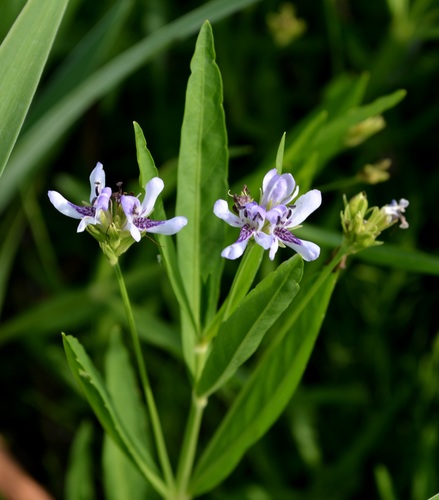
American water-willow
Justicia americana
A hardy, water-loving wildflower that forms lush green islands and provides vital habitat for river life across Eastern North America.
Quick Identification
Size
Grows 20–100 cm (8–40 inches) tall, often forming large, dense colonies in shallow water.
Colors
Bright green stems and leaves; flowers are white to pale lavender with distinct purple spots or streaks on the lower petals.
Key Features
- Opposite, linear leaves resembling willow foliage
- Orchid-like white flowers with purple-spotted throats
- Square-ish stems that grow directly out of shallow water
- Extensive colonial growth via underwater rhizomes
When You’ll See Them
Geographic range
Where Does the American water-willow Live?
Native to the eastern half of the North American continent, the American water-willow is a common sight across a vast territory stretching from the Great Lakes down to the Gulf of Mexico. Its core range spans the eastern United States—from New York and Michigan south to Texas and Florida—and extends into parts of southern Ontario and Quebec in Canada. You'll typically find it lining the rocky shoals of rivers or the silty banks of quiet ponds where it can establish its colonial roots.
Basemap © OpenStreetMap contributors
Behavior
The American water-willow is a resilient perennial that behaves more like a structural architect than a simple wildflower. It spreads primarily through an aggressive system of underground rhizomes, allowing it to form dense, stabilize colonies in the middle of flowing rivers or along lake shorelines. These "islands" of vegetation serve as critical infrastructure for local ecosystems, acting as a natural filter for water and a nursery for small fish.
While it appears delicate, this plant is built for the chaos of moving water. Its flexible stems can bend with the current during floods without snapping, and its roots are experts at anchoring in rocky or silty substrates. In the backyard or local park setting, it provides a hub of activity for pollinators, particularly specialized bees that have learned to navigate its unique flower structure.
EverydayEarth exclusive
Camera Tips
Capturing the American water-willow with an AI camera requires a different strategy than tracking mammals. Because these plants grow directly in or over the water, use a waterproof housing and a stable tripod weighted with rocks to prevent the current from sweeping your gear away. Position the camera at a low angle, roughly 6 inches above the water level, to get a dramatic 'insect-eye' view of the blooms.
To capture the plant's role in the ecosystem, set your camera to 'Motion Trigger' with high sensitivity. This will help you document the wide variety of visitors, from Great Blue Herons hunting near the stalks to the many bees and butterflies that visit the purple-spotted flowers. Mid-morning light is ideal, as it highlights the intricate markings on the petals without the harsh glare of midday sun reflecting off the water.
Consider using a time-lapse setting over several weeks during late spring. This allows you to watch the 'colony' expand and the flowers unfurl in sequence. If your camera has a macro lens or setting, focus specifically on the flower's throat—the AI recognition software on many platforms is better at identifying the plant when the unique floral pattern is clearly visible in the frame.
Similar Species
Species that look similar or are commonly confused with American water-willow.
Frequently Asked Questions
Record American water-willow at your habitat
Connect a camera to start building your own species record — AI identifies every visitor automatically.