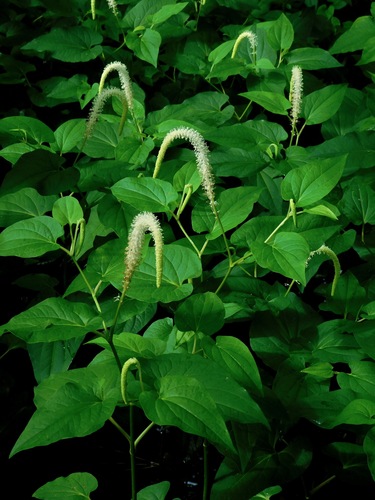
lizard's tail
Saururus cernuus
An elegant wetland resident, lizard's tail transforms muddy shorelines into lush green sanctuaries topped with nodding, fragrant white plumes. Its unique 'tail' of flowers and heart-shaped leaves make it a favorite for both pollinators and backyard pond enthusiasts.
Quick Identification
Size
Stems reach 2 to 4 feet (60–120 cm) in height; flower spikes are 4 to 8 inches (10–20 cm) long.
Colors
Lush, medium-to-dark green foliage with tiny, creamy white flowers densely packed on a pale green stem.
Key Features
- Heart-shaped or lance-shaped leaves with prominent veins
- Slender, arching white flower spikes that droop at the tip
- Spicy, citrus-like fragrance when the foliage is crushed
- Dense, colony-forming growth habit in wet soil
When You’ll See Them
Behavior
Lizard's tail is a hardy, colony-forming perennial that thrives in the saturated soils of North American wetlands. Unlike many other aquatic plants that grow in isolated clumps, this species spreads aggressively via an underground network of rhizomes. This growth pattern allows it to create dense 'forests' in shallow water, providing essential structural habitat for small fish, aquatic insects, and amphibians seeking refuge from predators.
The plant is best known for its unique flowering strategy. Each 'tail' is actually a complex cluster of hundreds of tiny, individual flowers lacking petals. These spikes emerge in mid-summer and have a characteristic 'nod' or 'droop' at the top, which gives the plant its common name. While it stays stationary, its interaction with the environment is dynamic; the leaves provide a platform for dragonflies to perch, and the fragrant blooms attract a variety of specialized pollinators, particularly beetles and small bees.
EverydayEarth exclusive
Camera Tips
Capturing the elegance of lizard's tail requires a low-profile approach. Since these plants thrive in muddy or shallow water, mount your camera on a short stake or a specialized ground mount just a few inches above the water line. Angle the lens slightly upward toward the drooping white spikes to emphasize their unique shape against the sky or dark wetland background. Because the flowers are a bright, reflective white, they can easily 'blow out' in direct midday sun; try to position your camera in a spot that receives dappled light or set your exposure compensation down if your camera allows it.
To capture the true 'wildlife' aspect of this plant, focus your camera on a specific, healthy bloom. Lizard's tail is a high-traffic hub for pollinators. Use a high-speed trigger or video mode to catch the split-second landings of dragonflies or the slow crawl of flower beetles. If your camera has a macro mode or a close focal distance, this is the perfect time to use it, as the intricate texture of the flower spike is fascinating when viewed up close.
For a truly unique perspective, consider a long-term time-lapse. Set your camera to take a photo every hour during the peak summer months. When played back, you will see the 'nodding' of the flower spikes as they follow the light and the rapid expansion of the green colony as it marches across the shoreline. This reveals the 'slow-motion' behavior of the plant that is invisible to the naked eye.
Don't forget the base of the plant! In the evening or early morning, amphibians like tree frogs or spring peepers often use the broad, heart-shaped leaves as resting pads. Position a second camera near the water's surface aimed at the lower leaves to catch these nighttime visitors. Infrared flash works well here, as it won't disturb the amphibians but will highlight their reflective skin against the matte texture of the leaves.
Similar Species
Species that look similar or are commonly confused with lizard's tail.
Frequently Asked Questions
Record lizard's tail at your habitat
Connect a camera to start building your own species record — AI identifies every visitor automatically.