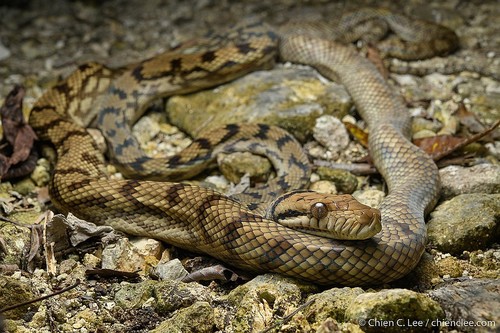
Amethyst Python
Simalia amethistina
The Amethyst Python is a shimmering giant of the tropical canopy, famous for the brilliant purple iridescence that dances across its scales. As one of the world's longest snakes, it is a magnificent and vital apex predator of the New Guinea rainforests.
Quick Identification
Size
Typically 2 to 5 metres (6.5 to 16.5 feet), with rare specimens exceeding 8 metres (26 feet); weighs 10 to 30 kg (22 to 66 lbs)
Colors
Brown, olive, and tan base with dark zig-zag or banded patterns; famous for a vivid purple or blue iridescent sheen on the scales when reflecting light
Key Features
- Strong iridescent purple/blue sheen on scales
- Large, distinct symmetrical shields on the top of the head
- Heat-sensing pits located in the scales of the snout and lower jaw
- Relatively slender, elongated body compared to other giant pythons
When You’ll See Them
Geographic range
Where Does the Amethyst Python Live?
The Amethyst Python is native to the tropical islands of Oceania and Southeast Asia. Its core range is centered on the island of New Guinea, spanning both Papua New Guinea and the Indonesian provinces of Papua and West Papua. It is also commonly found on surrounding islands including the Bismarck Archipelago, the Maluku Islands, and the Tanimbar Islands, thriving in the high-humidity environments of these equatorial regions.
Basemap © OpenStreetMap contributors
Behavior
The Amethyst Python is a masterful climber and a predominantly nocturnal predator. While they spend much of their time in the canopy of tropical rainforests, they are equally comfortable on the ground, often moving between trees or hunting for terrestrial prey. They are solitary creatures, generally avoiding contact with humans, though they are known to be quite defensive and strike readily if they feel cornered or threatened.
As an ambush predator, this python uses a combination of its keen eyesight and heat-sensing pits to locate warm-blooded animals in the dark. Once it strikes, it uses powerful constriction to subdue its prey. In areas where human development encroaches on their habitat, they are known to venture into suburban gardens or take up residence in the rafters of sheds and houses where rodents are plentiful.
EverydayEarth exclusive
Camera Tips
Capturing an Amethyst Python on camera requires a focus on height. These snakes are highly arboreal, so placing your camera 2 to 4 metres up a tree trunk, angled slightly downward toward a thick horizontal branch, is far more effective than a ground-level setup. Look for 'wildlife highways'—areas where canopy branches overlap or thick vines connect different parts of the forest, as these are common travel routes for large pythons.
Lighting is the biggest challenge when photographing this species. Their scales have a high metallic iridescence that can easily wash out under a standard white flash. Use a 'No-Glow' or 'Black' infrared flash to capture the intricate patterns without spooking the snake or creating a massive glare on the scales. This also ensures you don't disturb their nocturnal hunting behavior.
Since pythons are cold-blooded, they may not always trigger standard Passive Infrared (PIR) sensors, especially if the ambient air temperature is close to the snake's body temperature. To combat this, set your camera to 'Time Lapse' mode during the night hours (e.g., one photo every 2-5 minutes) or use the highest sensitivity setting for motion detection. Positioning cameras near water sources or fruiting trees that attract bats and rodents can also increase your chances of a sighting.
Similar Species
Species that look similar or are commonly confused with Amethyst Python.
Frequently Asked Questions
Record Amethyst Python at your habitat
Connect a camera to start building your own species record — AI identifies every visitor automatically.