Australian Scrub Python
Reptiles Active at night

Australian Scrub Python

Simalia kinghorni

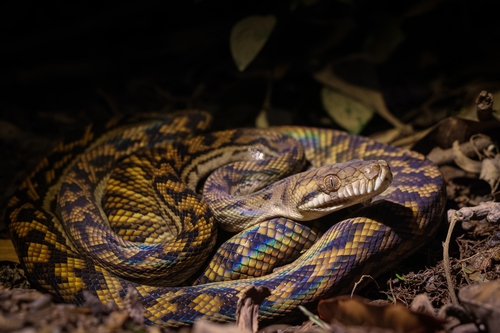
As Australia's longest snake, the Australian Scrub Python is a spectacular giant of the tropical north, known for its incredible climbing ability and shimmering, iridescent scales.

0 Sightings
0 Habitats

Quick Identification

straighten

Size

3-7 meters (10-23 feet) in length; weight typically 10-20 kg (22-44 lbs)

palette

Colors

Iridescent olive-brown or tan base with dark brown to black irregular cross-bands or blotches; pale cream or white belly

visibility

Key Features

  • Australia's longest snake
  • Large, distinct head with heat-sensing pits on the jaw
  • Slender, muscular body with highly iridescent scales
add_a_photo
Is this an Australian Scrub Python?

Drop a photo or video, or paste from clipboard

When You’ll See Them

schedule
Activity pattern Active at night
brightness_5
Peak hours 7 PM - 3 AM
calendar_month
Season September-January
restaurant
Diet Ambush predator feeding on birds, fruit bats, possums, and occasionally small wallabies or domestic pets
park
Habitat Rainforests, woodlands, monsoon forests, and suburban gardens with dense vegetation

public Geographic range

Where Does the Australian Scrub Python Live?

Native to the tropical regions of northern Australia, this species is a quintessential resident of Queensland. Its core range stretches from the tip of the Cape York Peninsula down through the humid tropics to the area around Townsville. These snakes are most commonly encountered along the coastal lowlands and the rugged terrain of the Great Dividing Range, where the lush vegetation provides ample cover and prey.

Basemap © OpenStreetMap contributors

1 Countries
450K km² Range
Least Concern Conservation
AU Australia
eco
iNaturalist / Verified observation data
View on iNaturalist open_in_new

Explore more Reptiles arrow_forward

Behavior

The Australian Scrub Python is a master of the canopy, spending much of its life high above the ground. They are primarily solitary and nocturnal, utilizing advanced heat-sensing pits along their lips to 'see' the heat signatures of warm-blooded prey in complete darkness. During the day, they typically retreat to tree hollows, dense clumps of epiphytic ferns, or even the roof cavities of suburban homes to thermoregulate and digest their meals.

While they have a reputation for being defensive, these pythons generally prefer to avoid human interaction. If cornered, they may hiss loudly and strike with impressive speed, but they are non-venomous constrictors. During the breeding season (usually winter to early spring), males become much more active as they travel through the forest or suburban corridors following the pheromone trails of females.

photo_camera EverydayEarth exclusive

Camera Tips

To capture the Australian Scrub Python, height is your best friend. Instead of the usual ground-level setup, mount your camera 2 to 3 meters high on a sturdy tree trunk, angled to look across horizontal 'highways'—thick branches that connect the canopy. These snakes are highly arboreal and often use the same branches repeatedly to navigate through the forest or into backyard spaces.

Nighttime performance is critical, so ensure your camera is set to its highest infrared sensitivity. Because these snakes can be incredibly long, a wide-angle lens is preferred to capture more than just a mid-section of the body as they glide past. Avoid using cameras with a bright white flash, as this can startle the animal and cause it to drop from the branch or leave the area immediately; 'no-glow' black IR is the gold standard here.

If you live in a suburban area where these snakes are known to reside, aim your camera at potential entry points like roof eaves or along the top of fence lines. Since they are ambush predators, they don't respond to traditional baits, but placing a camera near a known bird nesting site or a water feature can increase your odds of a sighting. Ensure your PIR (motion) sensor is set to high sensitivity, as their slow, fluid movement can sometimes be missed by slower triggers.

Frequently Asked Questions

Australian Scrub Pythons are primarily nocturnal, meaning they are most active at night. They typically emerge from their resting spots shortly after sunset to hunt for prey or find mates, though they may be seen basking in filtered sunlight during cooler mornings.
To attract an Australian Scrub Python, focus on creating a diverse habitat that supports their prey. Planting native trees that attract birds and possums, and providing dense canopy cover, will make your yard an attractive hunting ground. However, be mindful that these snakes may also be attracted to outdoor pet enclosures.
Their diet consists entirely of vertebrates. They are specialists at catching warm-blooded animals like fruit bats, possums, and various bird species. Large individuals have been known to take down small wallabies or scrub turkeys.
Yes, they are quite common in suburban areas of North Queensland, particularly in towns like Cairns and Cooktown. They often adapt well to human environments, using roof cavities as warm shelter and hunting in well-watered suburban gardens.
You can distinguish them by their size and scales. Australian Scrub Pythons grow much longer (up to 7 meters) and have much larger, more irregular scales on the top of their head compared to the small, fragmented scales found on the head of a Carpet Python.

Record Australian Scrub Python at your habitat

Connect a camera to start building your own species record — AI identifies every visitor automatically.

Join free Identify a photo