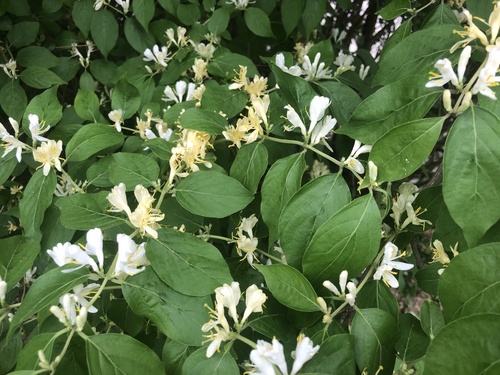
Amur honeysuckle
Lonicera maackii
A hardy and vigorous Asian shrub that dominates forest edges with its fragrant spring blooms and prolific red autumn berries.
Quick Identification
Size
A large, multi-stemmed shrub reaching 15–20 feet (4.5–6 meters) in height with a spread of 10–15 feet (3–4.5 meters).
Colors
Dark green leaves; white flowers that fade to creamy yellow; translucent bright red berries; grayish-brown shaggy bark.
Key Features
- Opposite leaves with distinct pointed tips
- Hollow brownish pith inside mature stems
- Fragrant tubular flowers in pairs
- Bright red berries clustered at leaf axils
- One of the first plants to leaf out in early spring
When You’ll See Them
Geographic range
Where Does the Amur honeysuckle Live?
Native to the temperate regions of Eastern Asia, including China, Japan, Korea, and southeastern Siberia, the Amur honeysuckle was introduced to North America in the late 19th century. It has since become a dominant invasive species across the Eastern and Midwestern United States and parts of Southern Canada. It thrives particularly well in disturbed landscapes where human activity has cleared native vegetation.
Basemap © OpenStreetMap contributors
Behavior
Amur honeysuckle is a highly successful and aggressive deciduous shrub. Its primary ecological strategy is 'seasonal phenology'—it is typically the first plant to produce leaves in the spring and the last to lose them in the fall. This allow it to capture sunlight before and after native canopy trees have their leaves, effectively shading out competition and creating dense, monocultural thickets.
The plant produces an abundance of fragrant flowers that are highly attractive to bees, butterflies, and moths. In late summer and autumn, it produces heavy crops of red berries. While these berries are widely eaten by birds, they are considered nutritionally inferior to native fruits, as they are high in sugar but low in the essential fats required for bird migration. The shrub also exhibits allelopathy, releasing chemicals into the soil that can inhibit the germination of other plant species nearby.
In suburban and urban environments, it is often viewed as a nuisance due to its rapid spread and ability to choke out gardens and forest edges. However, its dense structure provides significant nesting cover for birds like Northern Cardinals and American Robins, though studies suggest these nests may be more prone to predation due to the shrub's low branching structure.
EverydayEarth exclusive
Camera Tips
Using Amur honeysuckle as a focal point for your trail camera is a great way to capture bird and insect diversity. Because this shrub is often the first to turn green in early spring, it becomes a natural magnet for every bird in the neighborhood. Mount your camera 4 to 5 feet off the ground, angled slightly downward to capture the activity on the lower arching branches. If you can find a branch with heavy flower clusters in May, you'll likely capture hummingbirds and clearwing moths.
In the fall, when the bright red berries appear, position your camera near the fruit clusters. To increase your chances of capturing diverse wildlife, place a bird feeder or a water source within 5 to 10 feet of the bush. Birds will often use the honeysuckle as a 'staging area,' perching in its dense branches to scan for predators before hopping over to the feeder. This provides excellent, natural-looking shots of species like Cedar Waxwings and Goldfinches.
For the best image quality, try to place the camera so that it faces North or South to avoid direct lens flare from the sun, which can be exacerbated by the plant's shiny, translucent berries. If your camera has a macro or close-focus setting, use it to capture the intricate details of the white and yellow flowers. In winter, the shaggy bark and arching structure of the plant make for beautiful, high-contrast photos during snowstorms, often capturing overwintering birds looking for shelter.
Similar Species
Species that look similar or are commonly confused with Amur honeysuckle.
Frequently Asked Questions
Record Amur honeysuckle at your habitat
Connect a camera to start building your own species record — AI identifies every visitor automatically.