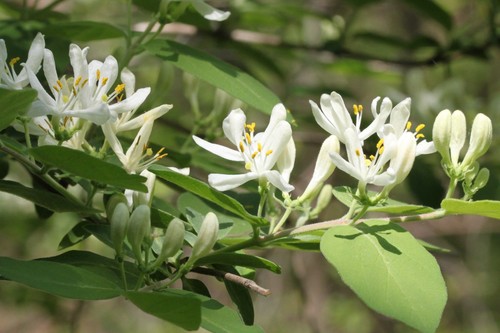
Morrow's honeysuckle
Lonicera morrowii
A vigorous master of the early spring, Morrow's honeysuckle creates lush, flowering thickets that transform backyard landscapes. While its fragrant blooms and bright red berries are visually striking, this invasive shrub is a powerful competitor that reshapes local ecosystems.
Quick Identification
Size
Height of 1.8–2.5 meters (6–8 feet) and a spread of up to 3 meters (10 feet)
Colors
Dark green leaves with grayish undersides; white flowers that age to creamy yellow; bright red to orange berries; pale gray-brown shaggy bark
Key Features
- Multi-stemmed upright shrub with arching branches
- Hollow brown pith in mature stems
- Leaves are hairy on the underside and arranged in opposite pairs
- Fragrant tubular flowers that transition from white to yellow
- Pairs of glossy red or orange berries at leaf bases
When You’ll See Them
Behavior
Morrow's honeysuckle is an aggressive deciduous shrub known for its 'early bird' strategy—it is often the first plant to leaf out in the spring and one of the last to drop its leaves in autumn. This phenological head-start allows it to shade out native wildflowers and seedlings before they even begin to grow. It thrives in a variety of conditions, forming dense, nearly impenetrable thickets that can dominate a backyard or woodland edge within just a few seasons.
While the shrub produces a massive quantity of berries, they are frequently described as 'avian junk food.' The fruit is high in sugar but lacks the essential fats and lipids found in native berries, which migratory birds rely on for energy. Despite this, birds are the primary drivers of its spread, consuming the fruit and dispersing seeds across miles of territory. In suburban environments, it acts as a 'green wall,' providing privacy for homeowners but creating an ecological desert for specialized native insects.
EverydayEarth exclusive
Camera Tips
To capture the best wildlife activity around Morrow’s honeysuckle, mount your camera at chest height (about 4-5 feet) approximately 6-10 feet away from the shrub’s outer canopy. This distance is ideal for capturing visiting songbirds like Cedar Waxwings, Northern Cardinals, and Catbirds as they hover or perch to feed on the berries. Because the berries are most abundant on the sun-exposed outer branches, positioning your camera on the south-facing side of the bush will yield the most frequent triggers and the best natural lighting.
Because this species forms dense interior thickets, it is a high-traffic zone for small mammals like Gray Squirrels and Eastern Cottontails seeking cover. Consider placing a secondary camera lower to the ground, aimed at the base of the multi-stemmed trunk. Use a high-sensitivity motion trigger setting, as the movement of a bird flitting between branches can be very fast. If your camera supports 'Photo + Video' mode, use it to document the specific feeding behaviors of birds, which can help you identify species even if they are partially obscured by foliage.
The most dramatic footage is often captured during the 'leaf-out' period in early spring. Set your camera to a timelapse mode with a 1-hour interval during April to see how this plant aggressively claims the canopy before native trees. During the fruiting peak in late summer, switch back to motion-activated video. Be mindful of the bright red berries; they can cause overexposure in direct midday sun. Angling the camera slightly downward or choosing a location with dappled shade will help preserve the rich color of the fruit in your recordings.
In the winter months, the shrub remains a focal point for wildlife because of its structure. Use your camera to monitor the shaggy bark and hollow stems, which often host overwintering insects that attract Downy Woodpeckers. Even without leaves, the arching branches provide a beautiful, complex backdrop for capturing wintering birds or foxes moving through the undergrowth. Documenting the seasonal changes of this plant provides valuable data on how invasive species alter the timing of local wildlife activity.
Similar Species
Species that look similar or are commonly confused with Morrow's honeysuckle.
Frequently Asked Questions
Record Morrow's honeysuckle at your habitat
Connect a camera to start building your own species record — AI identifies every visitor automatically.