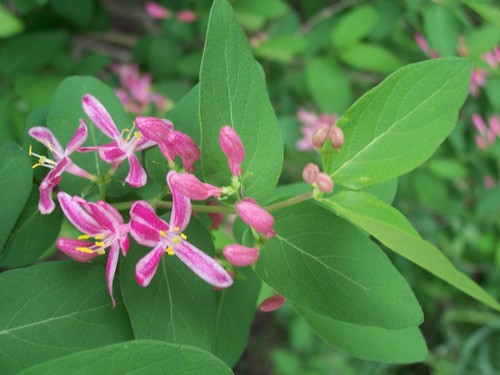
Tatarian honeysuckle
Lonicera tatarica
A hardy and fragrant invasive shrub, Tatarian honeysuckle paints the spring landscape with pink blossoms and the summer with red berries. While beautiful, this persistent plant is a master of survival that reshapes every backyard it enters.
Quick Identification
Size
Grows 3-10 feet (1-3 meters) tall and wide with a multi-stemmed, arching habit.
Colors
Dark green leaves; flowers range from white to deep pink; berries are bright red or occasionally orange.
Key Features
- Opposite, oval-shaped leaves that are hairless
- Hollow brownish pith (inner stem)
- Paired, tubular flowers with five petals
- Small, fleshy red or orange berries in pairs
- Shaggy, grayish-tan bark on older branches
When You’ll See Them
Behavior
Tatarian honeysuckle is an aggressive, invasive shrub that has successfully naturalized across much of North America. It is notable for its 'early-leafing' strategy, being one of the first plants to turn green in the spring and one of the last to drop its leaves in the fall. This allows it to monopolize sunlight and nutrients before native species even wake up from dormancy, often creating a dense 'monoculture' where nothing else can grow beneath it.
In the backyard ecosystem, it acts as a double-edged sword. Its fragrant spring blooms provide abundant nectar for pollinators like hummingbirds and bumblebees, and its late-summer berries are a prolific food source for birds. However, biologists note that its berries are nutritionally inferior to native fruits, providing high sugar but low fat, which can negatively impact birds preparing for long migrations. Its dense growth also provides nesting cover for songbirds, though these nests are often more vulnerable to ground predators like raccoons due to the shrub's low branching structure.
EverydayEarth exclusive
Camera Tips
To capture the best imagery of Tatarian honeysuckle, focus on its transition through the seasons. During the late spring bloom (May to June), position your camera on a tripod or mount it to a nearby fence post about 4 feet high, angled toward a dense cluster of pink flowers. Use a high-speed trigger setting or video mode to catch hummingbirds and clear-wing hawkmoths, which are frequent visitors to the tubular blossoms. Bright, indirect morning light is best to prevent the vibrant pinks from appearing 'blown out' in your photos.
In the late summer (August through September), move your camera to focus on the ripening red berries. This is the prime time to capture bird activity. Place the camera 5-8 feet away from the shrub with a clear line of sight to a fruiting branch. Because the foliage is quite dense, you may need to use a manual focus or 'Zone Focus' setting if your camera allows it; otherwise, the sensor may accidentally focus on a foreground leaf blowing in the wind rather than the bird eating the berries.
If you are using a trail camera to monitor invasive species growth, set it to 'Time Lapse' mode with a trigger interval of once per day at noon. Over the course of a year, this will provide a fascinating look at how the shrub dominates the landscape, leafing out weeks before the surrounding trees. For identification purposes, ensure you get a clear close-up of the bark and, if possible, a cross-section of a dead twig; the hollow center is a diagnostic feature that separates this invasive plant from native look-alikes.
Similar Species
Species that look similar or are commonly confused with Tatarian honeysuckle.
Frequently Asked Questions
Record Tatarian honeysuckle at your habitat
Connect a camera to start building your own species record — AI identifies every visitor automatically.