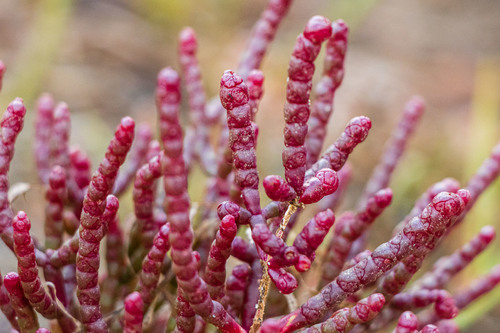
Annual Glasswort
Salicornia meyeriana
A master of survival in the saltiest soils on Earth, the Annual Glasswort transforms from a modest green succulent into a brilliant carpet of crimson. This 'sea asparagus' is a vital anchor for coastal ecosystems and a favorite of coastal foragers.
Quick Identification
Size
10-30 cm (4-12 inches) in height with a spread of up to 50 cm (20 inches)
Colors
Bright emerald green during growth; transitions to striking crimson, pink, or deep purple in autumn or under high salinity stress
Key Features
- Segmented, succulent leafless stems
- Cylindrical, jointed branches
- Turns brilliant red in late season
- Spikes of tiny, inconspicuous flowers
- Found in salt-encrusted soils
When You’ll See Them
Geographic range
Where Does the Annual Glasswort Live?
Native to the southern regions of Africa, Annual Glasswort is most commonly found along the coastlines of South Africa, Namibia, and Mozambique. It also thrives in the arid interior of Botswana and South Africa where seasonal salt pans create the specific hyper-saline conditions it requires. While this specific species is centered in Southern Africa, closely related members of the Salicornia genus can be found in similar coastal niches globally.
Basemap © OpenStreetMap contributors
Behavior
Annual Glasswort is a pioneer halophyte, a specialized plant that has evolved to thrive in environments where salt concentrations would kill most other vegetation. It grows in dense, succulent mats, using its fleshy segments to store water and its unique physiology to sequester salt within its vacuoles. As an annual, its entire life cycle—from germination in the moist mud of spring to its spectacular color change and eventual death—occurs within a single year.
While it may appear stationary, the plant is highly reactive to its environment. It plays a crucial role in soil stabilization and provides essential cover for small crustaceans and mollusks. For humans, the plant has a long history of use; it is often foraged as 'sea asparagus' for its salty, crunchy stems which are considered a gourmet delicacy in many coastal regions.
EverydayEarth exclusive
Camera Tips
Capturing the Annual Glasswort with an AI-powered camera requires a shift from motion-triggering to time-lapse photography. Because the plant is stationary, use your camera’s scheduled capture mode to take one or two photos a day over several months. This allows you to create a stunning visual record of its life cycle, particularly the dramatic transition from lush green to fiery red as the seasons change.
Position your camera on a low-profile ground stake or a small tripod just a few inches above the marsh surface. Angle the lens slightly downward to capture the intricate, jointed texture of the stems. Be mindful of the tide; if you are in a coastal estuary, ensure your camera is placed above the high-water mark or is housed in a professional-grade waterproof casing, as salt water is highly corrosive to electronics.
For the best lighting, aim for the 'golden hours'—shortly after sunrise or before sunset. The low-angle light catches the translucent skin of the succulent stems, making the plant appear to glow from within. If your camera allows for macro settings, focus on a single cluster of stems to capture the tiny, scale-like leaves that are characteristic of the species. Monitoring these plants also provides a great opportunity to catch 'by-catch' footage of wading birds like plovers or herons that frequent these salty habitats.
Similar Species
Species that look similar or are commonly confused with Annual Glasswort.
Frequently Asked Questions
Record Annual Glasswort at your habitat
Connect a camera to start building your own species record — AI identifies every visitor automatically.