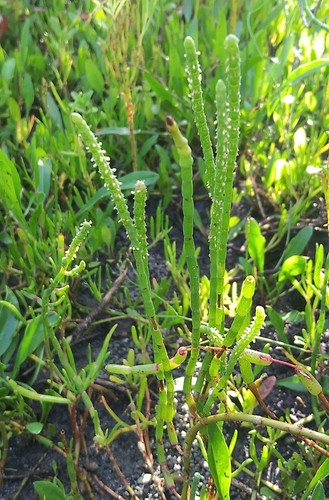
perennial glasswort
Salicornia ambigua
A resilient succulent that paints the coastline in shades of emerald and crimson, perennial glasswort is the ultimate survivor of the salt marsh. Its unique jointed stems and brilliant autumn transformation make it a captivating subject for any backyard coastal camera.
Quick Identification
Size
Height 10-30 cm (4-12 inches); trailing stems can form mats up to 1 meter (3.3 feet) in diameter
Colors
Bright emerald green to grey-green during spring and summer; transitions to deep red, orange, or purple in autumn
Key Features
- Succulent, jointed stems resembling miniature asparagus
- Leaves reduced to tiny, inconspicuous scales at stem joints
- Perennial mat-forming growth habit
When You’ll See Them
Behavior
Perennial glasswort is a highly specialized halophyte, meaning it is one of the few plants capable of thriving in extremely salty environments like salt marshes and tidal flats. Unlike many plants that wilt in salt, glasswort absorbs salt into its tissues and stores it in specialized vacuoles, which gives the plant its characteristic salty taste and succulent appearance. It plays a vital role in coastal ecosystems by stabilizing soil and providing a nursery for small crustaceans and juvenile fish during high tides.
As a perennial, this species maintains a woody base and regrows each year, unlike its annual relatives. It follows a rhythmic seasonal cycle: it remains dormant or dull in winter, bursts into bright green growth in the spring, and undergoes a dramatic chemical change in the fall. As the plant reaches the end of its growing season, it accumulates salts and pigments called anthocyanins, which turn the entire marsh landscape into a sea of brilliant crimson and purple.
EverydayEarth exclusive
Camera Tips
Capturing the beauty of perennial glasswort requires a different approach than filming mobile wildlife. Because this plant lives in the intertidal zone, the most dramatic footage often comes from capturing the interaction between the plant and the rising tide. Set your AI-powered camera on a low-profile tripod or a weighted base just above the high-tide line. Use a wide-angle lens to capture the 'carpet' effect of the glasswort mats as they are partially submerged by incoming water.
Time-lapse mode is your best friend for this species. Set your camera to take a photo every 30 to 60 seconds over a 6-hour period during a tide change. This will beautifully illustrate how the plant sways with the current and how the salt marsh transforms from land to sea. If your camera has a macro setting, get close—within 6 to 12 inches—to capture the unique segmented structure of the stems, which look like tiny green beads strung together.
Lighting is critical for bringing out the vibrant autumn reds. The 'Golden Hour' (the hour after sunrise or before sunset) provides soft, directional light that makes the translucent succulent stems glow. Avoid mid-day sun if you want to capture the subtle textures, as harsh overhead light can wash out the intricate details of the stem joints. If you are using an AI camera to detect motion, be aware that wind-blown movement of the glasswort might trigger frequent recordings; adjust your sensitivity settings or focus on a specific patch to avoid filling your storage with 'wind events.'
Finally, remember that perennial glasswort is often a hub for other wildlife. Position your camera to include a small patch of open mud or water next to the glasswort. You are likely to capture Fiddler Crabs scurrying among the stems or Herons and Egrets stalking prey along the edges of the glasswort mats. By focusing on the plant, you inadvertently create a perfect stage for capturing the broader salt marsh community.
Similar Species
Species that look similar or are commonly confused with perennial glasswort.
Frequently Asked Questions
Record perennial glasswort at your habitat
Connect a camera to start building your own species record — AI identifies every visitor automatically.