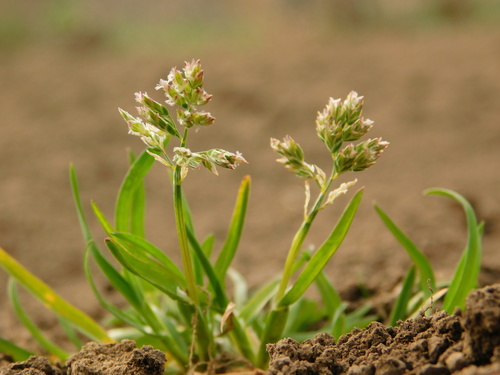
Annual Meadow-grass
Poa annua
The world's most successful 'uninvited guest,' Annual Meadow-grass is a hardy, bright green specialist that can grow everywhere from pristine golf greens to the cracks in your driveway.
Quick Identification
Size
Height ranges from 2-30 cm (1-12 inches), typically staying very low to the ground in mown areas.
Colors
Bright yellowish-green blades with pale, silvery-white to light green flower panicles.
Key Features
- Distinctive boat-shaped leaf tips
- Transverse wrinkles (crinkles) visible across the mid-section of the leaf blades
- Small, tufted, non-creeping growth habit
- Triangular, open flower spikes that can appear even at very low heights.
When You’ll See Them
Geographic range
Where Does the Annual Meadow-grass Live?
Annual Meadow-grass is a truly cosmopolitan species with a massive global footprint, believed to have originated in Europe and Central Asia as a natural hybrid. Today, it is found on every single continent, including isolated populations near research stations in Antarctica, making it one of the most widely distributed plants in the world. It is a dominant presence throughout the United States, Canada, the United Kingdom, and across the temperate zones of the Northern and Southern Hemispheres, thriving wherever human activity creates open, moist ground.
Basemap © OpenStreetMap contributors
Behavior
Annual Meadow-grass is one of the most successful and widespread plants on Earth, characterized by its incredible resilience and rapid life cycle. While its name suggests an annual nature, certain biotypes can behave as short-lived perennials in temperate, moist conditions. It is an opportunistic grower, quickly colonizing bare patches of soil, garden borders, and gaps between paving stones. Unlike many other grasses, it can produce seeds within just weeks of germinating, ensuring its survival even in frequently disturbed environments.
This species is particularly famous for its ability to survive intense mowing. While most grasses need to grow tall to flower, Annual Meadow-grass can produce viable seed heads even when cut to a height of just a few millimeters. This adaptive strategy makes it a permanent fixture in suburban lawns and golf courses. It doesn't have a complex social structure like an animal, but it interacts with human environments by thriving in high-nitrogen soils and areas with heavy foot traffic, where its small seeds are easily spread by shoes and lawnmower blades.
EverydayEarth exclusive
Camera Tips
Capturing Annual Meadow-grass with an AI-powered backyard camera or a smartphone requires a focus on macro details rather than movement. Because this grass is low-growing, place your camera on a ground-level mount or a low tripod. To get the best identification shot, aim for the leaf tips to show the 'boat' shape or get a close-up of the seed heads when they are in bloom. High-resolution settings are essential to see the tiny transverse wrinkles on the leaf blades that distinguish it from other meadow grasses.
For those using time-lapse features, Annual Meadow-grass is an excellent subject for documenting the rapid growth of a 'weed.' Set your camera to take a photo every hour over a period of two weeks in early spring. You will be able to watch the tuft expand and the flower spikes emerge with surprising speed. Ensure the area is well-lit, as the bright yellowish-green color of the blades pops beautifully against the darker greens of typical lawn grasses during the 'golden hour' of late afternoon.
If you are using a trail camera to capture wildlife, this grass often serves as a foreground indicator of soil moisture. In infrared night mode, the dense tufts can appear as bright spots. To avoid false triggers caused by the grass blowing in the wind, ensure the camera is positioned at least 2-3 feet away if it is mounted low, or use the 'sensitivity' settings to account for swaying blades during breezy days. This species is often visited by small foraging birds like finches and sparrows who eat the seeds; positioning your camera near a patch of seeding Poa annua can be an excellent way to capture bird activity without a traditional feeder.
Similar Species
Species that look similar or are commonly confused with Annual Meadow-grass.
Frequently Asked Questions
Record Annual Meadow-grass at your habitat
Connect a camera to start building your own species record — AI identifies every visitor automatically.