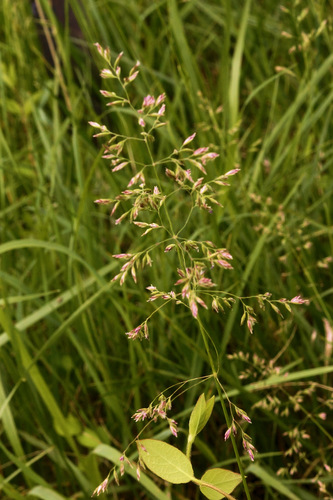
Smooth Meadow-grass
Poa pratensis
Often called the king of lawn grasses, Smooth Meadow-grass is a hardy perennial that forms the lush, emerald carpet of our suburban landscapes. Beyond the mower's reach, it reveals delicate, purple-tinged flowers and provides a vital foundation for backyard biodiversity.
Quick Identification
Size
30–70 cm (12–28 inches) tall during flowering; leaf blades 2–4 mm (0.08–0.16 inches) wide
Colors
Deep emerald green to bluish-green foliage; flowering panicles are green, often tinged with purple or gray
Key Features
- Distinctive boat-shaped or 'prow-shaped' leaf tips
- Pyramidal, branched flowering panicles
- Smooth, hairless stems and leaf sheaths
- Extensive network of underground rhizomes
When You’ll See Them
Behavior
Smooth Meadow-grass, widely known in North America as Kentucky Bluegrass, is a resilient perennial that spreads primarily through a sophisticated network of underground horizontal stems called rhizomes. This growth habit allows it to form a dense, sod-like mat that is incredibly effective at crowding out competitors and recovering from heavy foot traffic. Unlike many bunchgrasses, its ability to creep underground makes it a foundational species for stable, long-lasting grasslands and suburban lawns.
While it is celebrated for its soft texture and vibrant color, this grass plays a complex role in the wild. It is often one of the first plants to turn green in the spring and one of the last to go dormant in the winter, providing a consistent habitat for ground-dwelling micro-fauna. However, because it is so successful at colonizing new areas, it is frequently viewed as an invasive species in native North American prairies, where it can simplify the ecosystem by outcompeting native wildflowers and bunchgrasses.
EverydayEarth exclusive
Camera Tips
To capture the architectural beauty of Smooth Meadow-grass, you need to think like a macro photographer. Set your camera on a low-profile tripod or directly on the ground to achieve a 'bug’s-eye' perspective. This angle emphasizes the height of the flowering stalks (panicles) against the sky, creating a sense of scale that is often lost when looking down at a lawn. Using a wide aperture (f/2.8 to f/4) will help blur the background, making the delicate, branching structure of the seed heads pop against a soft green bokeh.
Lighting is the most critical factor for this species. The best time to photograph Smooth Meadow-grass is during the 'Golden Hour'—the first hour after sunrise or the last hour before sunset. Backlighting the grass during these times will make the fine hairs on the seed heads and the translucent edges of the blades glow. If you are using a trail camera, look for a spot where the sun breaks through the canopy in the morning; the condensation on the boat-shaped leaf tips creates stunning diffraction spikes that can make even a simple backyard patch look magical.
For those interested in the 'wildlife' aspect of the grass, consider a time-lapse setting. Over the course of late spring, you can document the rapid emergence of the purple-tinged flowering heads. Be mindful of the wind; even a light breeze will cause the slender stems to sway significantly. If your camera has a 'Pro' or manual mode, use a fast shutter speed (at least 1/500s) to freeze the motion, or intentionally use a slow shutter speed (1/10s or slower) during a breeze to capture the flowing, wave-like motion of a meadow.
If you are placing a camera specifically to monitor the health of your Smooth Meadow-grass, ensure the lens is positioned at least 18 inches away to avoid focal blur. In a backyard setting, avoid placing cameras near automatic sprinklers, as water spots on the lens will ruin your shots. Instead, aim for the edge of a flower bed where the grass meets a different texture, providing a natural frame for your composition.
Similar Species
Species that look similar or are commonly confused with Smooth Meadow-grass.
Rough Meadow-grass
Has a rougher texture on the leaf sheaths and prefers damp, shaded areas compared to the sun-loving Smooth Meadow-grass.
Annual Meadow-grass
A much smaller, tufted grass that lacks underground rhizomes and often flowers very close to the ground, even when mowed.
Perennial Ryegrass
Lacks the boat-shaped leaf tip and has a distinctive shiny, glossy underside to its leaves.
Frequently Asked Questions
Record Smooth Meadow-grass at your habitat
Connect a camera to start building your own species record — AI identifies every visitor automatically.