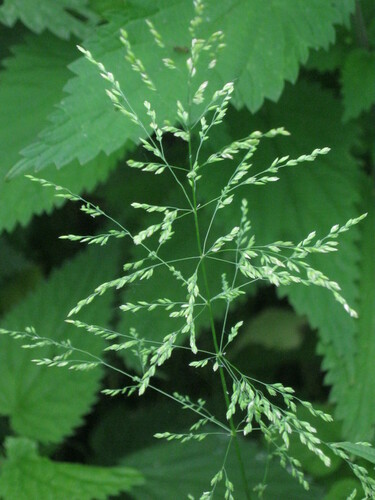
Rough Meadow-grass
Poa trivialis
A resilient, shade-loving grass that creates soft, light-green carpets in the dampest corners of your yard. Discover the intricate details and creeping growth of Rough Meadow-grass.
Quick Identification
Size
Stems reach 30–100 cm (12–39 inches) in height; leaf blades are 2–5 mm (0.08–0.2 inches) wide.
Colors
Light yellow-green foliage; leaf sheaths often have a purplish or brownish tint at the base; flower panicles are silvery-green to light brown.
Key Features
- Long, pointed ligule (4-10mm) at the leaf base
- Rough-textured leaf sheaths that feel sandpapery
- Distinctive boat-shaped leaf tips
- Creeping stolons (above-ground runners) that form dense mats
When You’ll See Them
Behavior
During the peak of spring, the plant transitions from vegetative growth to flowering, sending up delicate, airy panicles that sway in the wind to distribute pollen. While it is admired for its soft texture and vibrant light-green color in early spring, it has a notable seasonal behavior: it is sensitive to heat and drought. In the height of summer, the grass often enters a dormant state, turning a straw-colored brown until cooler, wetter weather returns in the fall.
EverydayEarth exclusive
Camera Tips
To successfully capture Rough Meadow-grass on your backyard camera, you need to think like a macro photographer. Because this species is low-growing, standard eye-level camera placements will miss the fine details. Mount your AI camera on a ground-level stake or a flat 'turtle' base, positioning the lens just 6 to 10 inches above the grass line. Tilt the camera slightly upward at a 30-degree angle. This perspective allows the camera to distinguish the 'rough' texture of the stalks and the unique, pointed ligules against the backdrop of the sky or taller garden foliage.
Since plants don't move in the traditional sense, use your camera’s Time-Lapse feature to document its growth. A setting of one photo every 15 minutes during the daylight hours will create a fascinating video of the 'circumnutation' (the circular waving motion) of the stems as they track the sun and the rapid expansion of the flower panicles during May and June. For the best color accuracy, ensure your camera is positioned to catch the 'Golden Hour' light shortly after sunrise; the low-angle sun highlights the silvery sheen of the seed heads and the translucent quality of the blades.
If you are using a motion-activated camera, you can still get great shots by using 'bait' for the creatures that visit the grass. Rough Meadow-grass provides excellent cover for ground-feeding birds like Sparrows or Juncos. Placing a small amount of birdseed directly within a patch of the grass will trigger the camera to capture high-resolution photos of the birds interacting with the stalks. In these shots, look for the 'boat-shaped' leaf tips in the foreground—a key identifier that helps you confirm the species in your AI-powered wildlife log.
Similar Species
Species that look similar or are commonly confused with Rough Meadow-grass.
Frequently Asked Questions
Record Rough Meadow-grass at your habitat
Connect a camera to start building your own species record — AI identifies every visitor automatically.