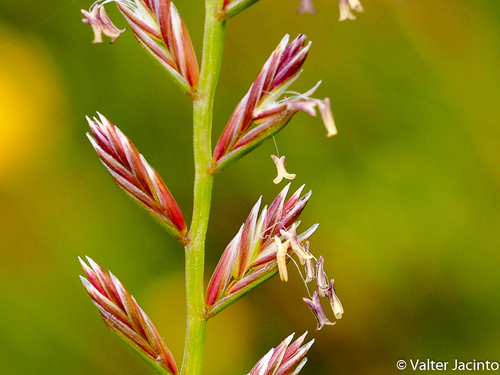
Perennial Ryegrass
Lolium perenne
The foundation of the classic green lawn, Perennial Ryegrass is a hardy survivor that brings life and texture to any backyard. Recognized by its shiny leaves and rapid growth, it provides essential forage and cover for a variety of wild visitors.
Quick Identification
Size
Height: 30–90 cm (12–35 inches) when in flower; blades are 2–6 mm (0.08–0.24 inches) wide
Colors
Bright, lustrous green leaves; stems often exhibit a distinct reddish-purple or pinkish tint at the base
Key Features
- Leaves are folded in the bud and appear shiny on the underside
- Base of the leaf sheath is typically reddish-purple
- Spikelets are attached directly to the stem in a zig-zag, alternate pattern
- Auricles (small ear-like appendages) are present but small at the leaf base
When You’ll See Them
Behavior
Perennial Ryegrass is a hardy, cool-season bunchgrass known for its rapid germination and aggressive growth. Unlike some grasses that spread via creeping underground runners, this species primarily grows in dense clumps or 'tussocks' and spreads through the production of tillers—new shoots that emerge from the base of the original plant. It is one of the first plants to turn vibrant green in the early spring, taking advantage of the cool, moist weather before the summer heat sets in.
In a backyard ecosystem, this grass acts as a primary producer and a crucial structural element. It provides a soft, durable carpet that many ground-dwelling insects and small mammals use for cover. While it is highly valued by humans for lush lawns and sports fields due to its ability to withstand heavy foot traffic, it also serves as a vital forage plant for grazing wildlife like rabbits and deer, and its seeds provide a nutrient-dense snack for songbirds during the late summer months.
EverydayEarth exclusive
Camera Tips
When photographing Perennial Ryegrass with an AI-powered camera, the goal is often to capture its growth cycle or its role as a backdrop for other wildlife. To capture the 'spring green-up,' set your camera to a time-lapse mode with one photo taken every 6 to 12 hours. This allows you to visualize the rapid vertical growth and the emergence of the seed heads, which are surprisingly architectural when viewed up close. Position the camera low to the ground—about 6 to 10 inches high—to get a 'mouse-eye view' of the blades.
Because this grass is highly reflective on its underside, it can sometimes cause 'hot spots' or overexposure in direct midday sun. To avoid this, set your camera to focus on the grass during the 'golden hours' of shortly after sunrise or just before sunset. If your camera allows for macro settings, try to capture the distinct reddish base of the stems, which is a primary identification feature. This color is most prominent in the early spring and late autumn, and using a neutral-colored background (like a dark garden stake or a piece of cardboard) behind the grass can help the camera’s AI lock focus on the fine texture of the leaf blades.
If you are using the grass as a 'trigger zone' for animal activity, place your camera so the Ryegrass is in the mid-ground. The swaying motion of the grass can be used to detect the movement of smaller animals like voles or ground-nesting birds that might otherwise remain invisible. To prevent false triggers from wind, adjust the sensitivity of your motion sensor, or focus the AI detection specifically on 'animal' tags rather than 'motion' tags. During the flowering stage, the spikelets (seed heads) attract many small birds; aim your lens at a height of 2 feet to capture the moment goldfinches or sparrows land on the swaying stalks to feed.
Similar Species
Species that look similar or are commonly confused with Perennial Ryegrass.
Frequently Asked Questions
Record Perennial Ryegrass at your habitat
Connect a camera to start building your own species record — AI identifies every visitor automatically.