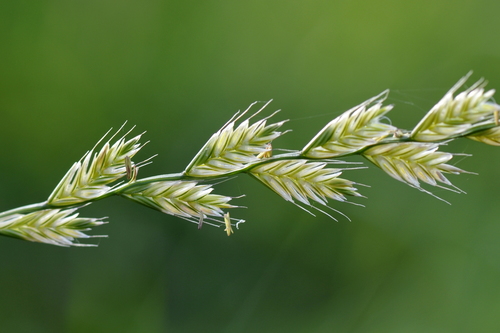
Italian Ryegrass
Lolium multiflorum
A fast-growing, glossy grass that brings life and movement to any backyard. Recognized by its tall, bristled seed spikes, Italian Ryegrass is a favorite of seed-eating birds and a vital habitat for beneficial insects.
Quick Identification
Size
Grows 30–100 cm (12–40 inches) tall; flower spikes can reach up to 30 cm (12 inches) in length.
Colors
Bright yellowish-green leaves with a distinct glossy or shiny underside; base of the stem is often tinged with reddish-purple.
Key Features
- Spikelets have long, needle-like awns (bristles)
- Leaves are rolled in the bud, not folded
- Conspicuous, claw-like auricles at the base of the leaf
- Glossy, hairless foliage with a reddish base
When You’ll See Them
Behavior
Italian Ryegrass is a vigorous annual or biennial grass known for its exceptionally fast growth rate and ability to colonize disturbed soils quickly. Unlike many slow-growing native grasses, it establishes a deep root system in a single season, making it a favorite for erosion control and temporary cover. It reproduces primarily through wind-pollination, releasing vast amounts of pollen from its tall, upright flower spikes during the late spring and early summer months.
While it is often planted for livestock forage or as a 'nurse crop' for slower-growing lawns, it can behave quite aggressively in backyard settings. It responds enthusiastically to nitrogen-rich fertilizers and frequent watering, often outcompeting other backyard flora. For the wildlife enthusiast, this grass serves as a foundational species, providing dense cover for ground-nesting insects and a high-energy seed source for granivorous birds once the flower spikes mature.
EverydayEarth exclusive
Camera Tips
Capturing the beauty of Italian Ryegrass requires a different approach than filming mobile wildlife. To showcase its growth, set your AI-powered camera to a time-lapse mode. A frequency of one photo every 4 to 6 hours over the course of two weeks will create a stunning visual record of its rapid vertical development and the unfurling of its glossy seed heads. Position the camera at a low 'worm’s-eye' view, roughly 6-10 inches off the ground, angled slightly upward to capture the dramatic silhouette of the awned spikelets against the sky.
Because grasses are stationary, use them as a 'stage' for other wildlife. Focus your camera on a dense patch of Italian Ryegrass during the early morning hours (6-8 AM) to capture birds like Finches or Sparrows landing on the stems to feed on the seeds. The heavy seed heads will often bow under the weight of the birds, creating dynamic movement that triggers motion sensors. Ensure your camera's sensitivity is dialed in; fine grass blades moving in a high wind can cause 'false' triggers, so aim for a sheltered spot or use a camera with 'zone detection' to focus only on the seed heads.
Lighting is crucial for this species due to its glossy leaf undersides. To capture the 'shine' that identifies Italian Ryegrass, position your camera with the sun behind it (front-lighting the plant) during the golden hours of late afternoon. This will highlight the texture of the leaves and the translucent quality of the flower glumes. If you are looking to capture the insects that frequent the grass, use a macro lens attachment or a camera with a close focal point, as the stems are often home to ladybugs and predatory beetles hunting among the blades.
Finally, consider the seasonal transition. In late summer, as the grass turns from bright green to a golden tan, the structural integrity of the plant changes. This is the best time to capture 'seed-shattering' events where wind or animal contact releases the next generation of plants. Using a high frame rate (60fps or higher) during these captures can reveal the intricate way the awns catch the wind, a detail often lost to the naked eye.
Similar Species
Species that look similar or are commonly confused with Italian Ryegrass.
Frequently Asked Questions
Record Italian Ryegrass at your habitat
Connect a camera to start building your own species record — AI identifies every visitor automatically.