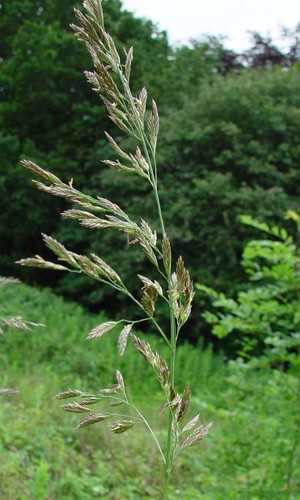
tall fescue
Lolium arundinaceum
The unsung hero of the hardy backyard, tall fescue is a deep-rooted, emerald-green grass that thrives where others fail. Its tough, bunching habit provides a rugged stage for everything from foraging robins to resting rabbits.
Quick Identification
Size
2-4 feet (60-120 cm) tall when flowering; leaves 4-12 inches (10-30 cm) long and 0.1-0.3 inches (3-8 mm) wide.
Colors
Dark emerald green foliage; mature seed heads are tan to light brown; base of the stem often shows a reddish-purple tint.
Key Features
- Coarse-textured, wide leaf blades with prominent parallel veins
- Distinctive 'bunched' or clump-forming growth habit
- Rough, serrated leaf edges that feel scratchy to the touch
- Deeply ridged upper leaf surface with a smooth, shiny underside
When You’ll See Them
Behavior
Tall fescue is a rugged, cool-season perennial grass that doesn't behave like your typical 'creeping' lawn grass. Instead of spreading through underground runners (rhizomes) or surface stolons, it grows in dense, individual clumps. This bunching behavior makes it incredibly hardy and resistant to heavy foot traffic, though it may require occasional overseeding to maintain a perfectly uniform look in a backyard setting.
One of its most fascinating 'behaviors' is its survival strategy. Tall fescue often hosts a symbiotic fungus called an endophyte. This internal partner produces alkaloids that make the grass taste bitter to insects and more resistant to heat and drought. Because of its deep root system, which can dive up to three feet into the earth, tall fescue stays green and active during the height of summer while other grasses enter a brown, dormant state.
EverydayEarth exclusive
Camera Tips
When setting up a camera to capture tall fescue, your biggest challenge isn't finding the subject, but managing its movement. Because tall fescue grows in tall, wispy stalks when left unmown, it is highly susceptible to wind. To prevent your AI camera from triggering thousands of 'false positive' videos on a breezy day, avoid placing the camera directly facing a large field of grass. Instead, use the grass as a foreground element or 'frame' for a known wildlife trail. If your camera has sensitivity settings, set them to 'Medium' or 'Low' to ensure only larger movements—like a rabbit or bird—trigger a recording.
To capture the most aesthetic shots of the grass itself, height and angle are everything. Mount your camera low to the ground, roughly 8 to 12 inches high, and tilt it slightly upward. This 'bug’s-eye view' highlights the architectural structure of the seed heads and the deep ribbing of the blades. For the best lighting, position the camera so it faces North or South; this allows the morning and evening 'Golden Hour' sun to sidelight the grass, making the emerald green color pop and highlighting the morning dew clinging to the blades.
If you are interested in documenting the growth of your backyard meadow, tall fescue is an excellent subject for time-lapse photography. Set your camera to take one photo every day at high noon over the course of the spring. This will allow you to see the dramatic 'flush' of growth as the grass emerges from winter dormancy and shoots up its flowering stalks. During the winter, keep your camera active; tall fescue provides one of the few splashes of green in a snowy landscape, making it a perfect backdrop for capturing the high-contrast colors of wintering birds like Cardinals.
Similar Species
Species that look similar or are commonly confused with tall fescue.
Frequently Asked Questions
Record tall fescue at your habitat
Connect a camera to start building your own species record — AI identifies every visitor automatically.