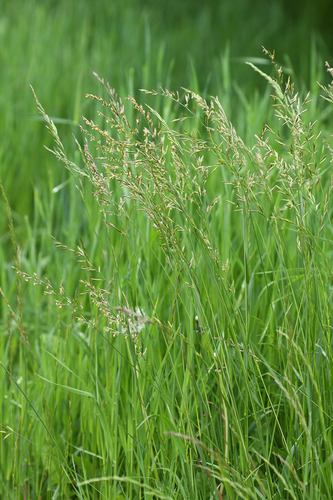
meadow fescue
Lolium pratense
A hardy, clump-forming perennial that anchors the meadow ecosystem. Meadow Fescue provides essential texture to the landscape and vital cover for the smallest backyard visitors.
Quick Identification
Size
30 to 120 cm (1 to 4 feet) tall; leaf blades 3 to 8 mm (0.1 to 0.3 inches) wide
Colors
Bright green to deep emerald foliage; glossy leaf undersides; seed heads turn straw-colored or golden-brown; reddish-purple tint often visible at the leaf sheath base
Key Features
- Densely tufted or 'clumpy' growth habit
- Smooth, glossy undersides on the leaf blades
- Branching flower head (panicle) that droops slightly to one side
- Absence of prominent 'ears' (auricles) where the leaf meets the stem
When You’ll See Them
Behavior
Meadow Fescue is a resilient perennial grass known for its 'bunchgrass' growth habit. Unlike invasive turf grasses that spread via underground runners, this species grows in thick, localized tufts, making it a favorite for sustainable meadows and high-quality forage. It is highly adaptable but performs best in cool, moist environments where its deep root system can access nutrient-rich soils.
While it remains relatively low to the ground for much of the year, it undergoes a dramatic transformation in late spring, sending up tall, elegant flowering stalks. It plays a quiet but vital role in backyard ecosystems, acting as a primary food source for various moth larvae and providing critical 'tussock' shelter for beneficial insects and small ground-dwelling mammals during the winter months.
EverydayEarth exclusive
Camera Tips
Capturing the subtle beauty of Meadow Fescue with an AI-powered camera requires a focus on movement and micro-details. Because AI cameras often trigger on motion, this grass is an excellent subject for windy days; the swaying 'nodding' motion of the seed heads can create beautiful, dynamic clips. Position your camera on a low tripod or ground mount, roughly 12 to 18 inches high, to get a 'bug's eye view' of the tufts. This perspective highlights the glossy sheen of the leaf undersides which is a primary identifying feature.
To capture the wildlife that depends on this grass, aim your camera at a transition zone where a patch of Meadow Fescue meets a lawn or woodland edge. Ground-feeding birds like sparrows and finches are frequently drawn to the seed heads in mid-summer. Additionally, the thick base of the fescue tufts is a highway for small mammals like voles and shrews; setting your camera to a high-sensitivity motion trigger near the base of the plant can reveal a hidden world of nocturnal activity that most homeowners never see.
Lighting is your best friend when photographing grasses. Schedule your recording or check your live stream during the 'golden hours'—shortly after sunrise or just before sunset. The low-angle light will catch the delicate textures of the flowering panicles and make the deep green blades glow. If you are using a trail camera, ensure the infrared flash isn't positioned too close, as the reflective, glossy surface of the fescue leaves can cause 'white-out' in night photos.
Similar Species
Species that look similar or are commonly confused with meadow fescue.
Frequently Asked Questions
Record meadow fescue at your habitat
Connect a camera to start building your own species record — AI identifies every visitor automatically.