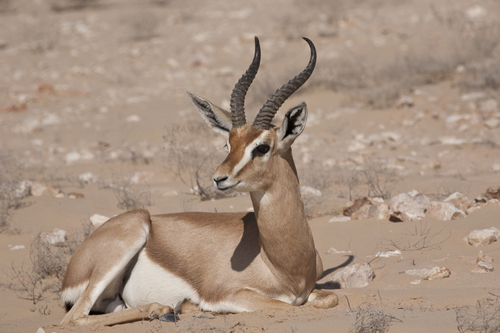
Arabian Gazelle
Gazella arabica
The Arabian Gazelle is the graceful ghost of the dunes, a master of survival in one of Earth's harshest climates. With its striking lyrate horns and incredible speed, it is the crown jewel of Middle Eastern backyard wildlife.
Quick Identification
Size
Shoulder height 55–65 cm (22–26 in); weight 18–25 kg (40–55 lbs); total length 90–120 cm (35–47 in)
Colors
Dark brown to grayish-brown upper body with a distinct dark lateral stripe; stark white underbelly and rump; white facial stripes bordered by black
Key Features
- S-shaped lyrate horns found in both sexes, though larger in males
- Dark brown or charcoal lateral stripe separating the flank and belly
- Distinct white 'mask' stripes running from the eyes to the muzzle
- Slender, elegant legs built for high-speed desert sprinting
When You’ll See Them
Geographic range
Where Does the Arabian Gazelle Live?
Native to the arid landscapes of Western Asia, the Arabian Gazelle is found throughout the Arabian Peninsula. Its core populations reside within Saudi Arabia, Oman, the United Arab Emirates, and Yemen, where it occupies everything from low-lying coastal plains to high-altitude mountain plateaus. While much of its range is naturally fragmented by extreme desert conditions, it remains the most iconic wild ungulate across the Middle Eastern desert landscape.
Basemap © OpenStreetMap contributors
Behavior
The Arabian Gazelle is a highly social and alert mammal, typically found in small family groups or herds of three to ten individuals. These groups are usually led by a dominant territorial male who defends his patch of desert with vigor. They are masters of the 'stott' or 'pronk'—a high-jump display where they leap into the air with all four legs stiff, signaling to predators that they are too fit to be worth chasing.
While naturally wary of humans, these gazelles have shown a remarkable ability to adapt to human presence in the Gulf region. In protected desert communities and rural farms, they may become habituated to residents, though they rarely lose their flighty nature. During the scorching midday heat, they typically seek shade under acacia trees, becoming more active as temperatures drop.
EverydayEarth exclusive
Camera Tips
To capture the Arabian Gazelle on camera, placement is everything. Position your camera approximately 2 to 3 feet (60–90 cm) off the ground—roughly knee-height for a human. This ensures you catch the animal's full profile and the intricate patterns on its face. If you are in a hilly area, aim the camera across a flat trail or toward a watering point to avoid capturing only the gazelle's back or legs.
Water is the most effective natural lure in the desert. Placing a camera near a localized drip irrigation line, a garden trough, or a natural 'wadi' seep will yield the best results, especially during the dry summer months. If you are in a residential area bordering the desert, these gazelles are often attracted to fallen dates or fresh alfalfa. A mineral salt lick placed in a quiet corner of a property can also encourage them to linger long enough for a high-quality capture.
Because the Arabian Gazelle is crepuscular, meaning it is most active during the low-light hours of dawn and dusk, your camera needs a fast trigger speed (0.3s or less) to catch them as they move quickly through the frame. Use a 'Burst Mode' setting of 3-5 photos to capture their fluid movements. At night, they can be skittish around standard white flashes, so an invisible 'No-Glow' Infrared flash is highly recommended to keep from startling the herd.
Similar Species
Species that look similar or are commonly confused with Arabian Gazelle.
Sand Gazelle
Much paler, cream-colored coat with a white face and less distinct lateral stripes; typically inhabits deep sand dunes.
Mountain Gazelle
Historically considered the same species, but often slightly larger with different genetic markers; primarily found in the Levant and northern Israel.
Frequently Asked Questions
Record Arabian Gazelle at your habitat
Connect a camera to start building your own species record — AI identifies every visitor automatically.