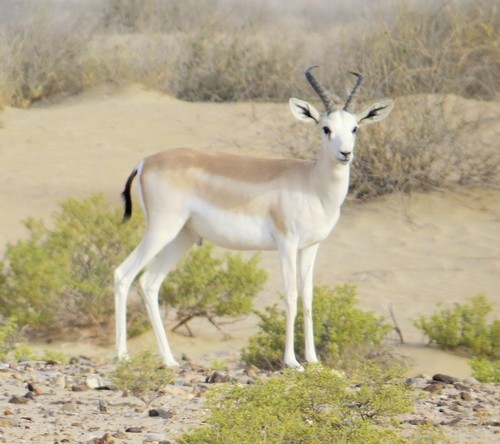
Sand Gazelle
Gazella marica
The 'ghost of the dunes,' the Sand Gazelle is a masterpiece of desert adaptation. With its ethereal pale coat and spiraled horns, it is one of the most iconic and resilient residents of the Arabian sands.
Quick Identification
Size
Shoulder height 55-65 cm (21-26 in); weight 18-30 kg (40-66 lbs)
Colors
Pale sandy-white coat with a pure white underbelly and rump; facial markings are faint and often fade to white in older individuals.
Key Features
- Lightest colored of all gazelle species
- Thick, lyrate-shaped horns on males that curve inward at the tips
- Females are unique for often having very small horns or being completely hornless
- Broad hooves specifically adapted for traveling over soft sand dunes
When You’ll See Them
Geographic range
Where Does the Sand Gazelle Live?
The Sand Gazelle is a native icon of the Middle East, primarily inhabiting the vast desert expanses of the Arabian Peninsula. Its core populations are found across Saudi Arabia, the United Arab Emirates, Oman, and Qatar, with smaller, fragmented groups extending northward into the Syrian Desert, Jordan, and Iraq. While once widespread across the region's sandy interior, their current range is increasingly concentrated within protected wildlife reserves and remote dune systems far from urban sprawl.
Basemap © OpenStreetMap contributors
Behavior
Sand Gazelles are highly social and resilient desert dwellers, typically living in small family groups that can congregate into larger herds of dozens or even hundreds during seasonal migrations or near scarce water sources. They are perfectly adapted to the hyper-arid environments of the Middle East, possessing the ability to shrink the volume of their heart and liver to reduce oxygen consumption and metabolic water loss during extreme droughts.
These gazelles are naturally wary and rely on their incredible speed and 'stotting' or 'pronking' behavior—jumping high into the air with all four legs stiff—to alert the herd of predators. While they are traditionally crepuscular, they often shift to a nocturnal lifestyle during the peak of summer to avoid the midday heat, spending their days resting in shallow beds they scrape into the sand in the shade of desert shrubs.
EverydayEarth exclusive
Camera Tips
To capture the Sand Gazelle on camera, placement is everything. These animals follow established 'game trails' through the dunes or gravel plains, often leading toward water troughs or known grazing patches. Position your camera low to the ground—about 20 to 30 inches high—to get an eye-level perspective that captures their delicate facial features and impressive horns. Angle the camera slightly upward if placing it at the base of a dune to account for their movement patterns.
Because the desert sun creates harsh glares and deep shadows, the best footage usually comes from the 'golden hours' of dawn and dusk or via infrared night vision. Ensure your camera has a fast trigger speed (0.3 seconds or less), as gazelles can be skittish and move surprisingly fast when startled. Setting your camera to 'Burst Mode' or 'Photo + Video' is highly recommended to catch the social interactions between herd members, which often occur in quick succession.
While baiting is generally discouraged in wild settings, providing a consistent, clean water source or a salt lick in a backyard or sanctuary setting is the most effective way to draw them in. In the heat of summer, Sand Gazelles will visit water points with clockwork regularity. Be mindful of the wind direction when checking your cameras; their sense of smell is incredibly sharp, and if they catch your scent on the equipment, they may avoid the area for several days.
Similar Species
Species that look similar or are commonly confused with Sand Gazelle.
Frequently Asked Questions
Record Sand Gazelle at your habitat
Connect a camera to start building your own species record — AI identifies every visitor automatically.