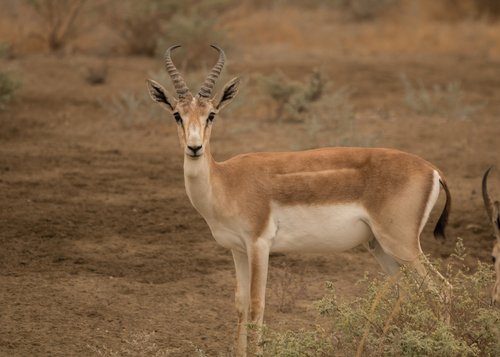
Goitered Gazelle
Gazella subgutturosa
The ghost of the steppes, the Goitered Gazelle is a master of desert survival, known for its incredible sprinting speed and the unique throat swelling of the males.
Quick Identification
Size
Length: 90–115 cm (35–45 in); Shoulder height: 40–66 cm (16–26 in); Weight: 18–33 kg (40–73 lbs)
Colors
Light sandy-brown coat on the back and sides, contrasting with a pure white belly and inner legs; distinguished by a jet-black tail and a white face that often loses its dark markings as the animal matures.
Key Features
- Distinctive swelling on the throat of males during breeding season
- Short, black tail that flicks constantly while moving
- Lyre-shaped, heavily ringed horns on males (females are usually hornless)
- Pale, sandy coloration that provides perfect desert camouflage
When You’ll See Them
Geographic range
Where Does the Goitered Gazelle Live?
The Goitered Gazelle is a quintessential survivor of the vast Eurasian arid belt, with a native range that stretches from the Caucasus through Central Asia into the heart of the Gobi Desert. Its territory begins in the west in Turkey, Azerbaijan, and Iran, extending across the sprawling steppes of Kazakhstan, Turkmenistan, and Uzbekistan. Further east, significant populations are found in the desert basins of northwestern China and across the rugged plains of Mongolia, though their distribution has become increasingly fragmented due to infrastructure development and hunting.
Basemap © OpenStreetMap contributors
Behavior
The Goitered Gazelle is a highly social and mobile species, known for its ability to cover vast distances in search of grazing land. Unlike many other gazelle species, they exhibit significant seasonal shifts in social structure. In the summer, they typically graze in small family groups or maternal herds, but as winter approaches, they congregate into massive herds that can number in the hundreds or even thousands, a strategy that helps them navigate the harsh, snowy winters of the Central Asian steppes.
These gazelles are famous for their speed and agility. When threatened, they don't just run; they perform a series of high-speed bounds, often reaching speeds of up to 60 km/h (37 mph). They are extremely wary of human presence and have keen eyesight and hearing, making them a challenge to approach. During the rutting season, males become highly territorial, using their namesake 'goiter'—an enlarged cartilaginous cylinder in the throat—to produce deep, guttural bellows that advertise their presence to rivals and mates alike.
EverydayEarth exclusive
Camera Tips
Capturing the Goitered Gazelle on camera requires a strategy focused on their nomadic search for water and minerals. In arid environments, the most successful placements are near isolated water sources or 'malkhans' (natural salt licks). Because these gazelles are naturally skittish and have excellent vision, mount your camera at a lower height—roughly 50 to 60 centimeters (20-24 inches) off the ground—to match their eye level while angling it slightly upward to capture the male's distinctive throat swelling and horns.
Use a 'No-Glow' or high-end 'Low-Glow' infrared flash. Goitered Gazelles are extremely sensitive to the red glow of standard IR emitters, which can spook them and prevent them from returning to the site. Fast trigger speeds are essential; these animals often move quickly across the frame rather than lingering. Set your camera for a 3-photo burst or a short 10-second video clip to ensure you capture the black tail, which is a key identification mark that is often only visible from the rear as they move away.
Timing is everything with this species. During the heat of the summer, they are strictly crepuscular, so ensure your camera's sensor is sensitive enough for low-light dawn and dusk transitions. In the winter months, however, they may be active throughout the day to take advantage of the sun's warmth, so keep your cameras running 24/7. Avoid placing cameras in areas with high human or livestock traffic, as Goitered Gazelles will actively avoid these zones even if resources are present.
Similar Species
Species that look similar or are commonly confused with Goitered Gazelle.
Frequently Asked Questions
Record Goitered Gazelle at your habitat
Connect a camera to start building your own species record — AI identifies every visitor automatically.